

Victoria Embankment Gardens is a narrow strip of formal garden squeezed between the Strand and the Thames, and walking it end to end turns out to be less about flowers and more about tripping over one memorial after another. Between Embankment station and the Savoy, the paths pass a poet, a blind economist, a Sunday School founder, an operetta composer mourned by a bronze nymph, and a seventeenth-century watergate that used to open straight onto the river.
I came here mainly to walk and enjoy a bit of summer weather, and as soon as I stepped in I could feel the atmosphere change: peaceful, green and full of flowers, tucked right in between two of the busiest stretches of central London. It almost feels like a little flower garden hidden in the middle of the city.
It is still a small, practical garden rather than a destination in itself: something to cut through, sit in for twenty minutes, or use as a hinge between Covent Garden and the South Bank. But almost everything in it has a plaque, and the plaques are worth reading.
The Flowers, and the Tulips in Particular
There are so many different types of flowers here, but the tulips are what really caught my attention on my visit: white, yellow, pink, red and some much darker shades too, in different varieties everywhere you look. It isn’t just one type of planting either; there’s always something new to look at as you move along the beds, and during the summer the colour really stands out against the green.
A Garden Built From River Mud
An interpretation board near the Villiers Street end lays out the whole story, and it is worth reading in full if you pass it. Sir Christopher Wren was reportedly the first to suggest embanking the river, after the Great Fire of 1666, but nothing happened for two centuries. Work finally began in 1864 under the Metropolitan Board of Works’ chief engineer, Sir Joseph Bazalgette, whose real motive was as much sewage as scenery: the Embankment was built to house London’s main sewer and stop it emptying straight into the Thames. The Metropolitan District Railway used the same works to extend the Circle line underneath.
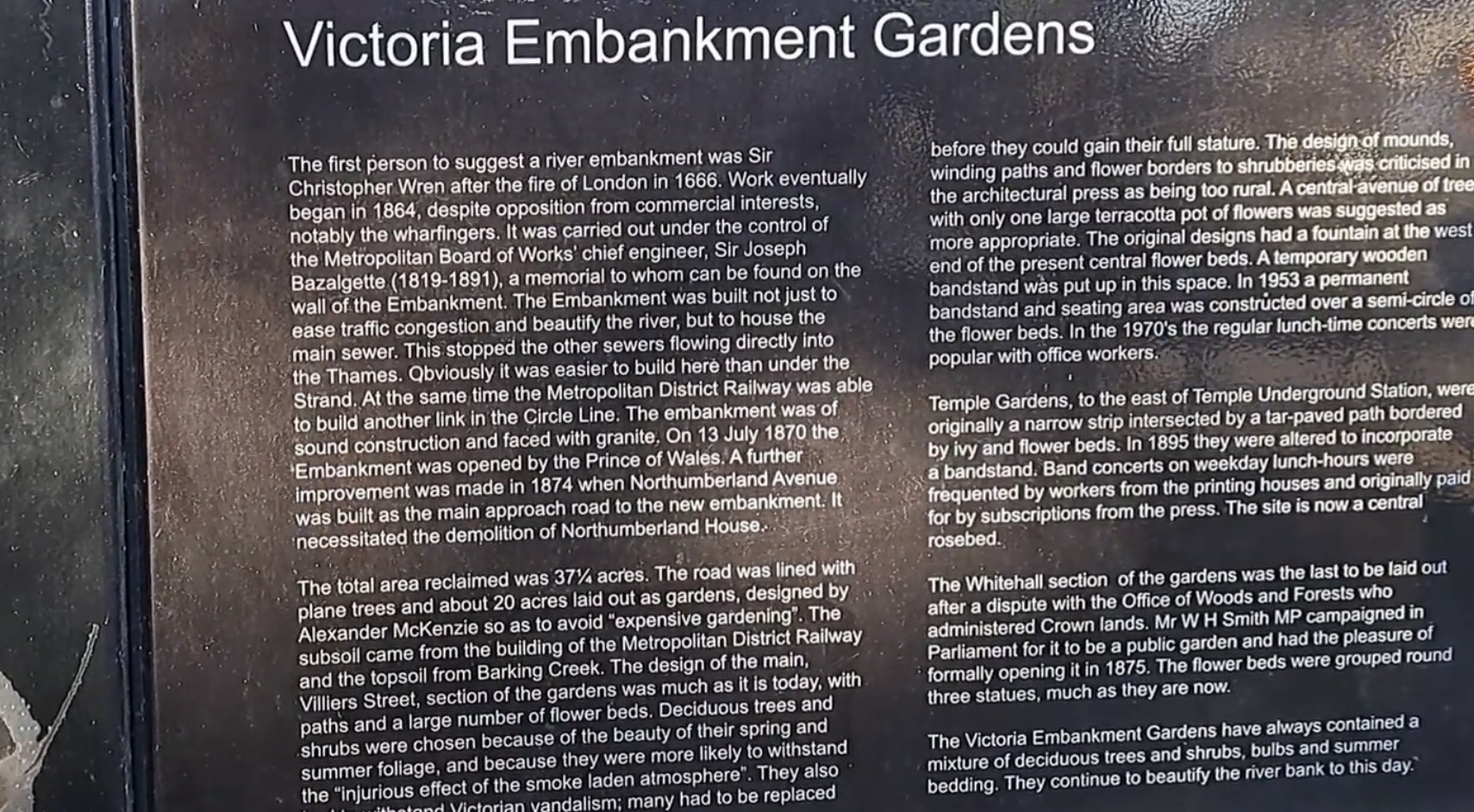
The Prince of Wales formally opened the Embankment on 13 July 1870. In total, 37¼ acres were reclaimed from the old foreshore, with around 20 acres laid out as gardens by Alexander McKenzie, who was told to avoid “expensive gardening.” The subsoil came from the District Railway diggings; the topsoil was brought in from Barking Creek. Deciduous trees and shrubs were chosen for spring and summer colour and because they coped better with London’s smoke, though many still had to be replaced before they matured, and critics at the time complained the winding paths and shrubberies looked too rural for a formal riverside garden.
A temporary wooden bandstand went up first; a permanent one, with a semicircular seating area, followed in 1953. Lunchtime concerts there were popular with office workers through the 1970s. Further along, Temple Gardens near the Underground station started as a narrow tar-paved strip bordered by ivy, gained its own bandstand in 1895, and is now a rose bed. The Whitehall section was the last piece finished, opened in 1875 by MP W. H. Smith after a dispute with the Office of Woods and Forests over the Crown land it sat on.
A Small Waterfall, and a Nice Surprise
One of the things I didn’t expect to find here was a small waterfall tucked into the gardens. It’s not large, but it adds a bit more character to the place and makes the whole area feel even more peaceful, with the sound of running water mixing in with everything else going on around it.
A Walk Through the Memorials
The gardens are, by London standards, unusually dense with statues, and none of them are grouped together in an obvious sculpture trail: you just meet them one at a time along the path.
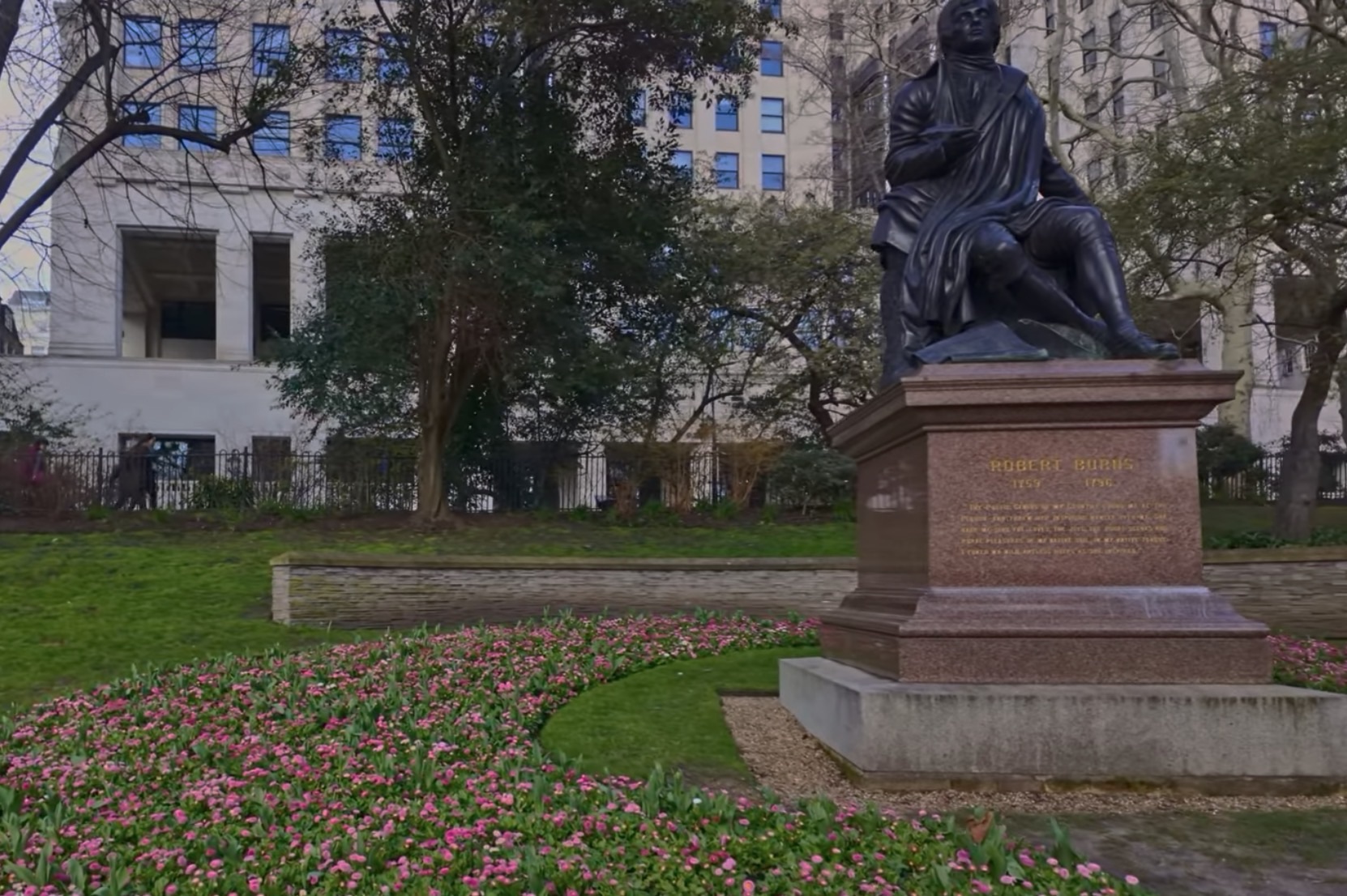
Near the Burns statue is a monument that is easy to under-read at a glance: a memorial to the officers, NCOs and men of the Imperial Camel Corps: British, Australian, New Zealand and Indian troops who died in Egypt, Sinai and Palestine between 1916 and 1918. It is a reminder that this is as much a war memorial garden as a horticultural one; further along are memorials to Lord Chelmsford, a former chairman of the London County Council, and a Belgian tribute to Britain for its support during the First World War.
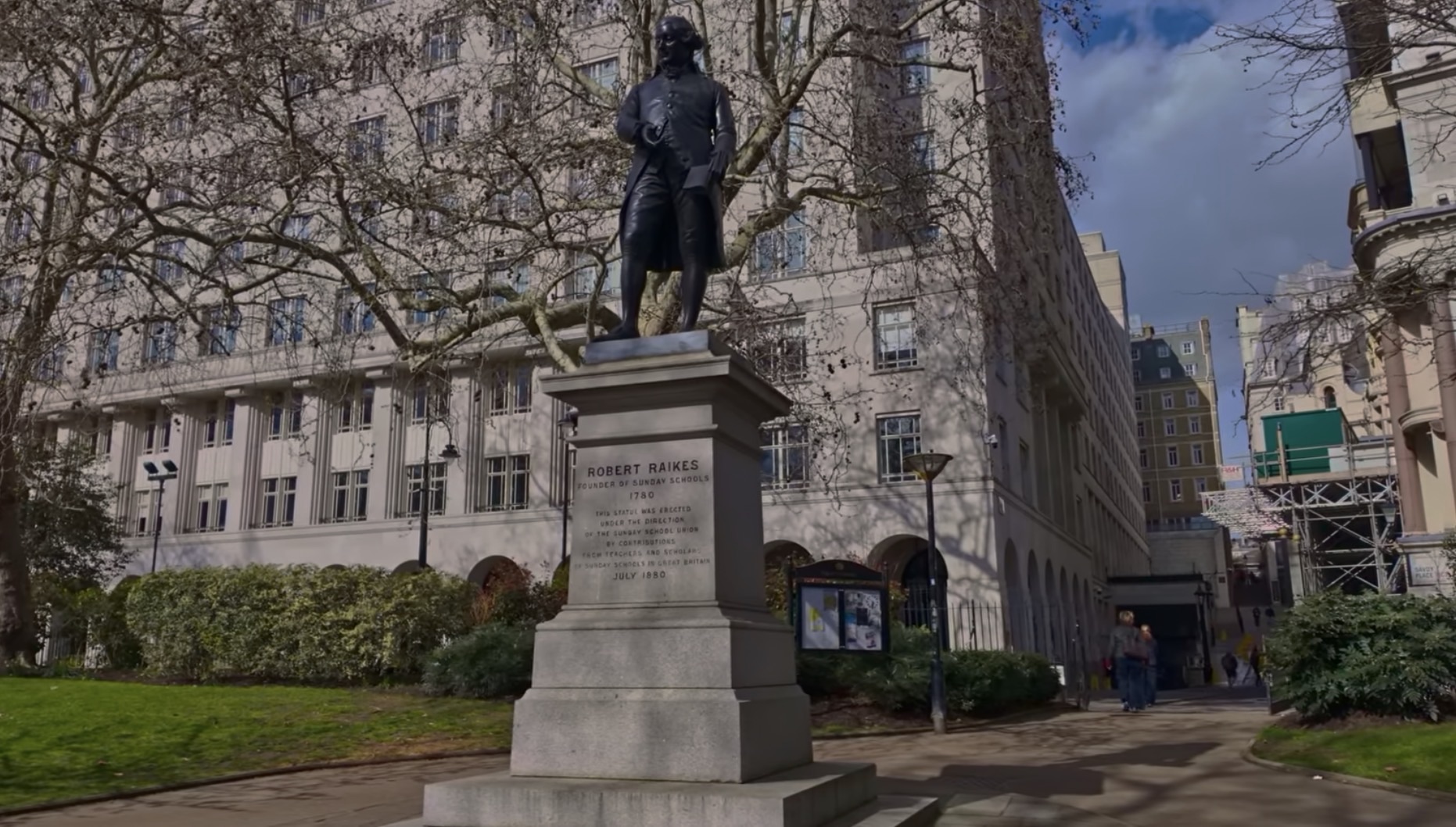
Robert Raikes founded the first Sunday School in 1780, self-funded, at a time when working children had only Sunday free of labour. His statue was raised in 1880, on the centenary, paid for in small contributions by teachers and pupils of Sunday schools across Britain. Within a hundred years his idea had grown from one classroom to reach roughly a quarter of the population.
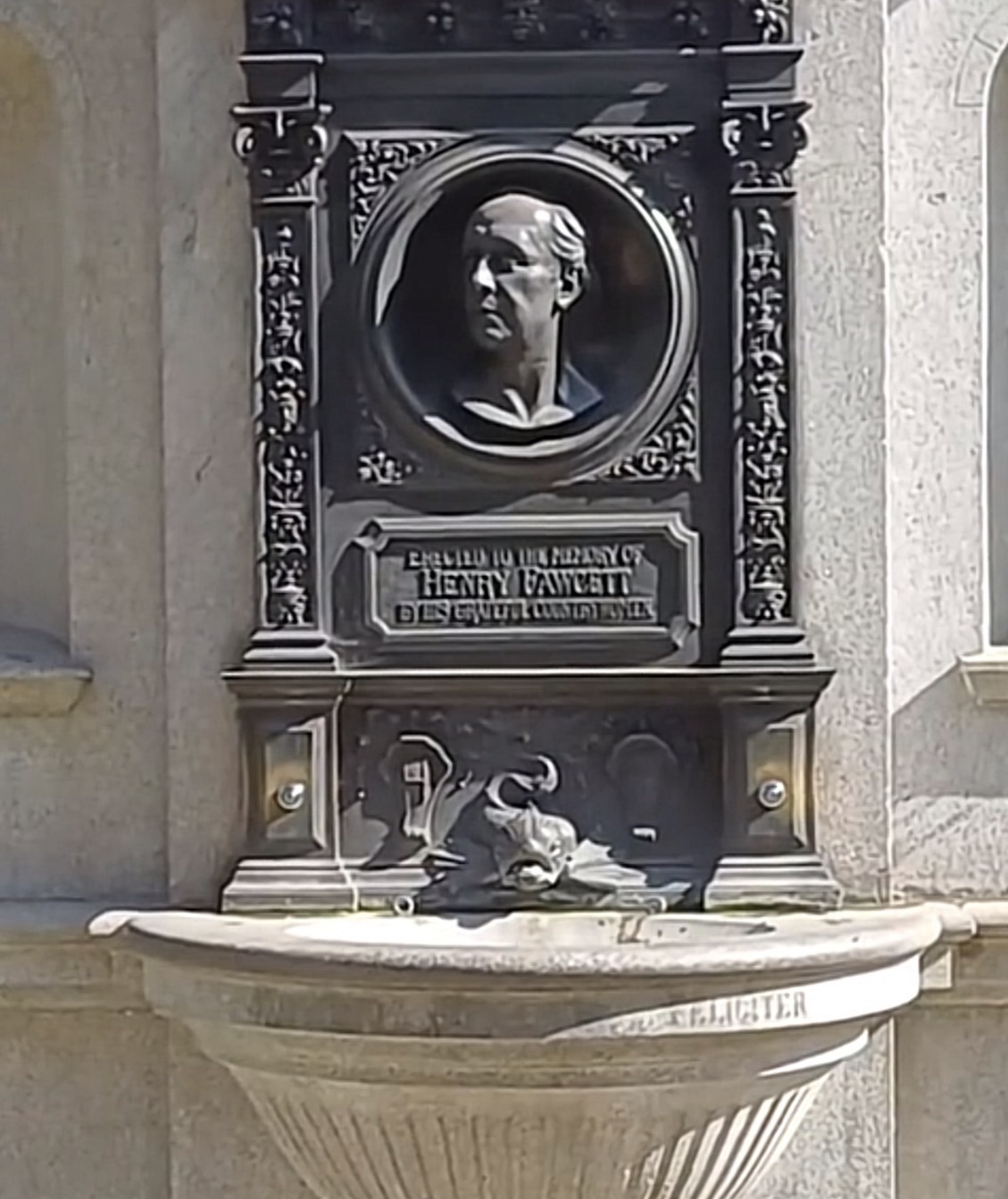
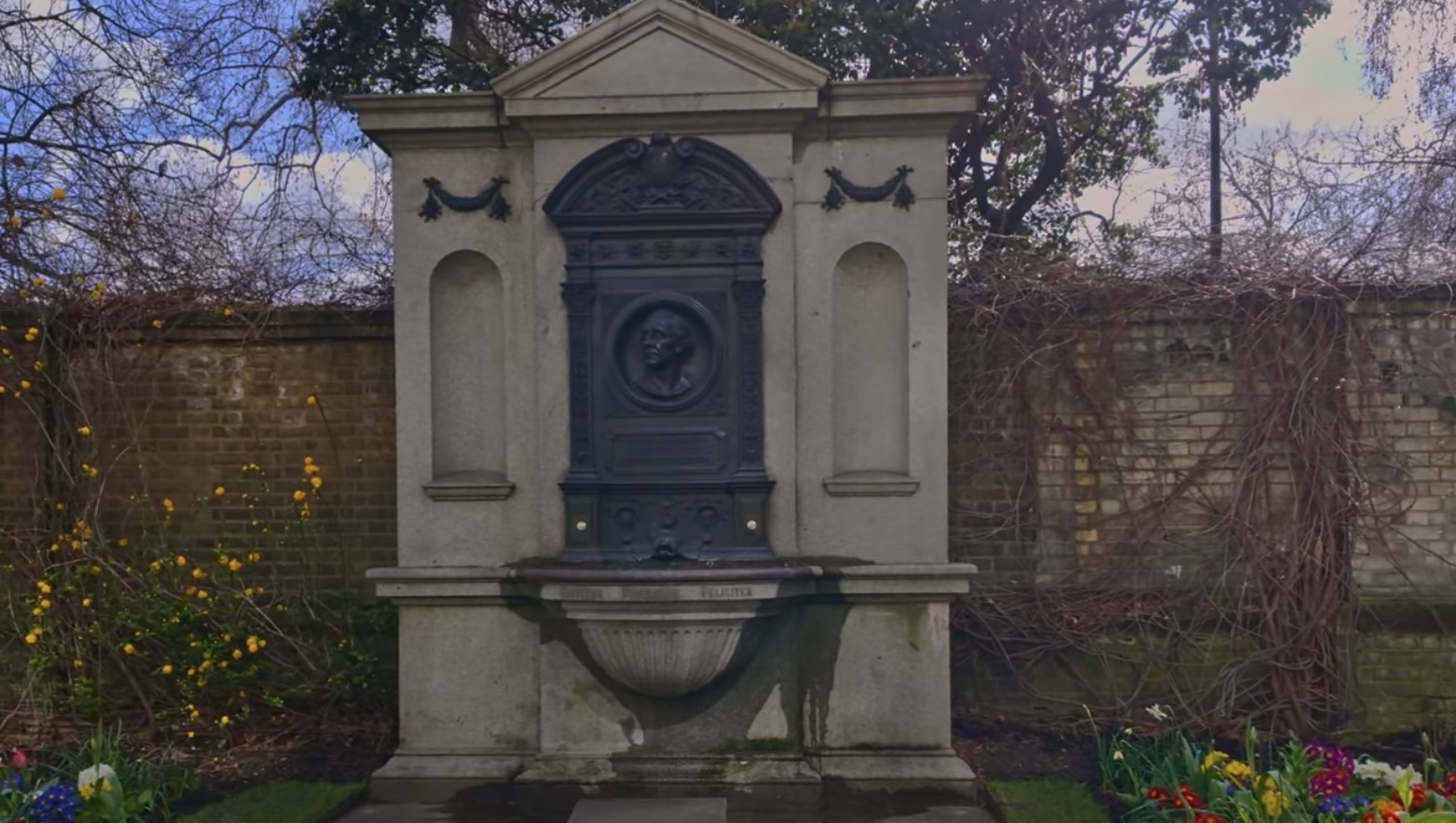
Henry Fawcett is one of the more quietly remarkable people commemorated here: an economist and MP who was blinded in a shooting accident as a young man, he went on to champion women’s suffrage in the 1880s, long before it was a fashionable cause, and to attend the famous 1860 Oxford evolution debate between Samuel Wilberforce and Thomas Huxley, siding with Huxley. The terracotta and bronze fountain, sculpted by Mary Grant with ornamental work by George Frampton, was erected in 1886 “by his grateful countrywomen.”
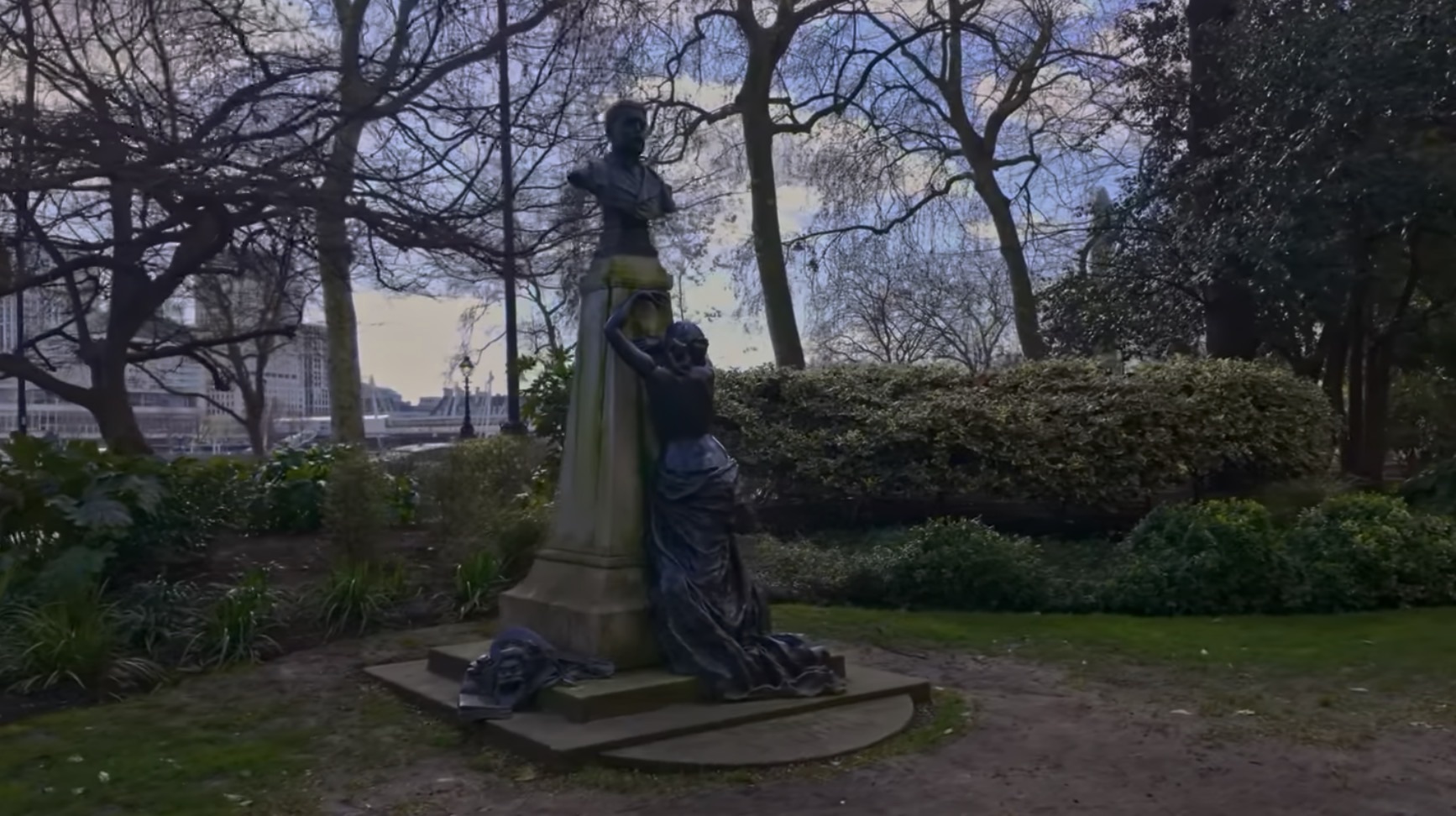
The most striking monument in the gardens is easily this one: a bronze bust of the composer Sir Arthur Sullivan, of Gilbert and Sullivan fame, with a half-draped female figure, usually read as a weeping or mourning muse, leaning against the plinth below, sheet music and a comedy mask at her feet. Unveiled in 1903 by Princess Louise, it quotes Gilbert’s own lyrics from The Yeomen of the Guard and has long had a reputation, only half-joking, as one of the more unexpectedly sensual public statues in London. Sullivan wrote far more than the Savoy operas, with The Lost Chord and Onward, Christian Soldiers among them, and the memorial sits close to the Savoy Theatre where his operas with W. S. Gilbert premiered.
Elsewhere in the gardens, smaller memorials reward slow walking rather than a checklist: a tree planted in 1953 for the coronation of Queen Elizabeth II, another planted in 1972 to mark a Britain in Bloom award, a pond given in 1915 by Alfred Bickerton, then chairman of the London County Council, and a memorial to Richard D’Oyly Carte, proprietor of the Savoy Theatre and Savoy Hotel and the man who brought Gilbert and Sullivan together in the first place.
York Water Gate
The Grade I-listed York Water Gate is the most important historic structure inside the gardens, and also the easiest to misunderstand until you know its story. Built around 1626 by master mason Nicholas Stone for George Villiers, first Duke of Buckingham, it served as the private river entrance to York House, which the Duke had acquired from the Archbishop of York in 1624. At high tide, his boat would come right up to the arch; the Duke would step out and walk up what is now Buckingham Street.
York House was demolished in 1675 and the streets around it, Villiers Street, George Street, Duke Street and Buckingham Street, were laid out to preserve his name and title, down to the alley still called Of Alley. The gate itself fell into decay until 1893, when the London County Council obtained parliamentary powers to acquire and preserve it. Its real significance only clicks once you notice how far it now stands from the water: the Thames used to reach almost to the gate; the Embankment pushed the river bank roughly 150 yards further out.
Families and the Play Area
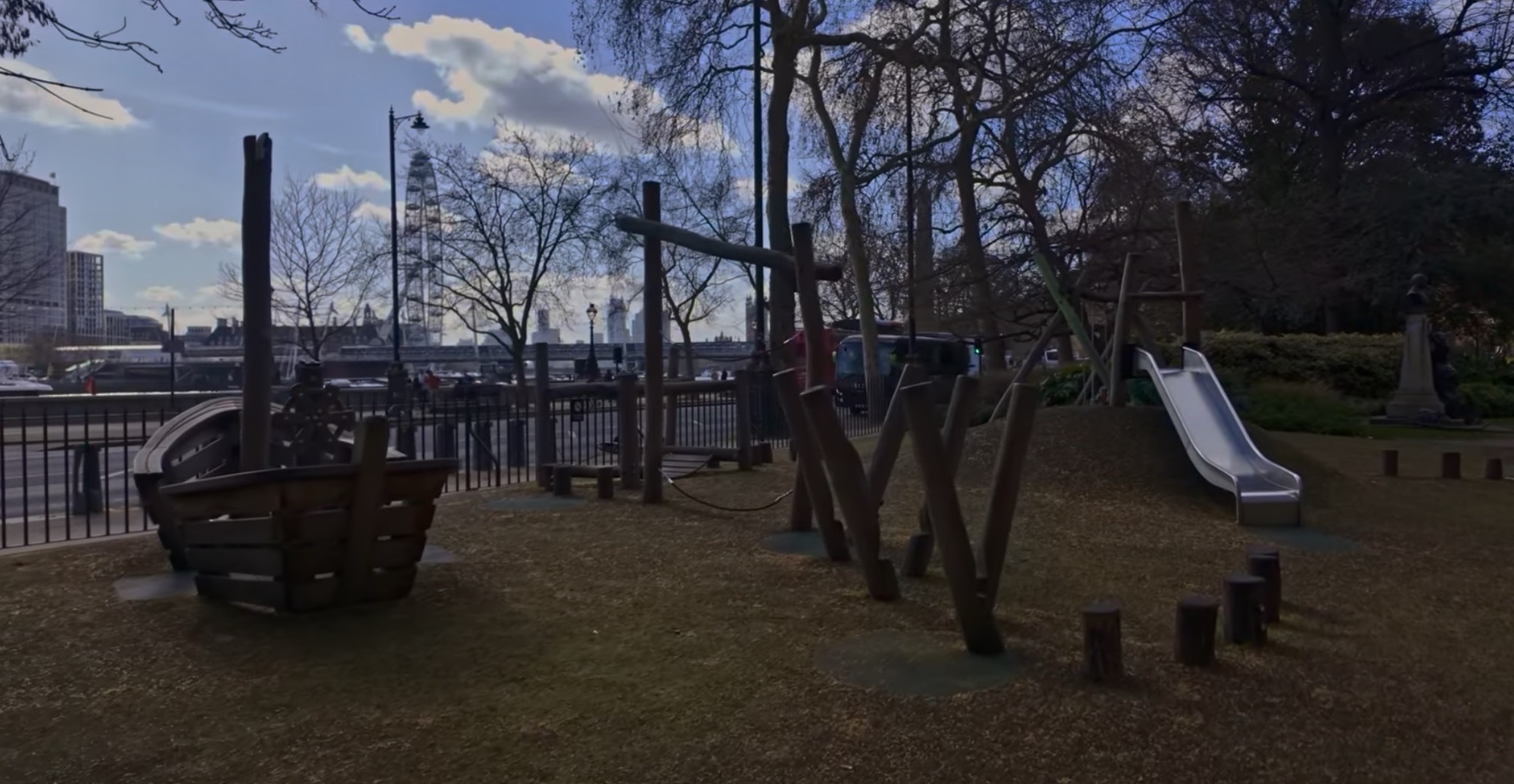
The play area sits close to the river wall, built largely from timber, with a wooden boat, climbing posts and a slide set into a small mound, and it works best as a short stop rather than a destination playground. Towards this end of the gardens it isn’t particularly large, but it’s a nice little area for children visiting, and the main advantage is the view: children playing on the boat are looking straight across the Thames at the London Eye and Hungerford Bridge, which is not a bad reward for behaving through a morning at the National Gallery.
Works Well For
- A picnic or snack break
- Short play between central London attractions
- Pushchairs on formal paths
- Looking at flowers and statues
- A calm stop before or after the South Bank
Less Suitable For
- A large destination playground
- Long nature walks
- Large ball games
- A full sports day
- Families wanting several child-specific attractions
A Short Route That Makes Sense
The Villiers Street side puts you straight into the most practical end of the gardens, beside the history board and York Water Gate.
It makes the later Embankment history much easier to understand.
Robert Burns, the Imperial Camel Corps memorial, Robert Raikes and the Henry Fawcett fountain appear in that rough order.
This is the best point for a short lunch or coffee break when seating is available.
Near the Savoy end, before continuing east towards Temple or back up to the Strand.
Food, Coffee and Picnics
There is a café inside the gardens, while Villiers Street and the Strand provide many additional options. On my visit, having a coffee here and just sitting on a bench watching people go by turned out to be one of the nicest parts of the whole walk. Some people were sitting quietly reading, others were chatting, a few were walking dogs, and others were simply enjoying the sunshine, everyone seemed to have their own way of using the space.
The gardens are particularly practical for a packed lunch. They are right next to Charing Cross and Embankment, which makes them an easy outdoor lunch spot for anyone working nearby. That convenience has a downside: on a sunny weekday, popular benches and lawn edges can become busy around the lunchtime period.
Toilets
Westminster lists public toilets at Victoria Embankment Gardens, Villiers Street, with accessible facilities and RADAR-key access.
The council currently gives the toilet opening time as 7:00am to 8:30pm daily. Those hours are separate from the seasonal park gates, so do not assume the gardens and toilets always close at exactly the same time.
Accessibility
Westminster lists the gardens as having disabled access. The formal nature of the site means the main experience is on surfaced paths rather than rough woodland tracks, which matches what the paths actually feel like underfoot: gravel and tarmac throughout, with no significant gradient.
Accessible public toilets are available. The park is also compact, so distances between entrances, seating and the main historic features are much shorter than in Westminster’s large Royal Parks.
Dogs
Westminster’s current policy says its parks are dog friendly unless specifically included on an exception list. Victoria Embankment Gardens is not listed among those exceptions.
Formal flower beds, lunch crowds and narrow paths mean close control is sensible, particularly during busy periods.
Parking
Driving is rarely the most practical way to visit, and I wouldn’t recommend it if you don’t need to. This is central Westminster, close to major public transport and within an area where parking is limited and controlled.
There is no reason to plan a visit around a dedicated park car park. Anyone who needs to drive should use Westminster’s live parking information rather than old street-parking advice.
Public Transport and the Best Entrance
Embankment Underground station is the obvious arrival point. TfL lists Bakerloo, Circle, District and Northern line services, and the station address is on Villiers Street. Walking straight through the station concourse and out the far side puts you almost directly into the gardens.
Charing Cross is also very close and adds National Rail connections. Walking down Villiers Street provides a direct approach to the gardens.
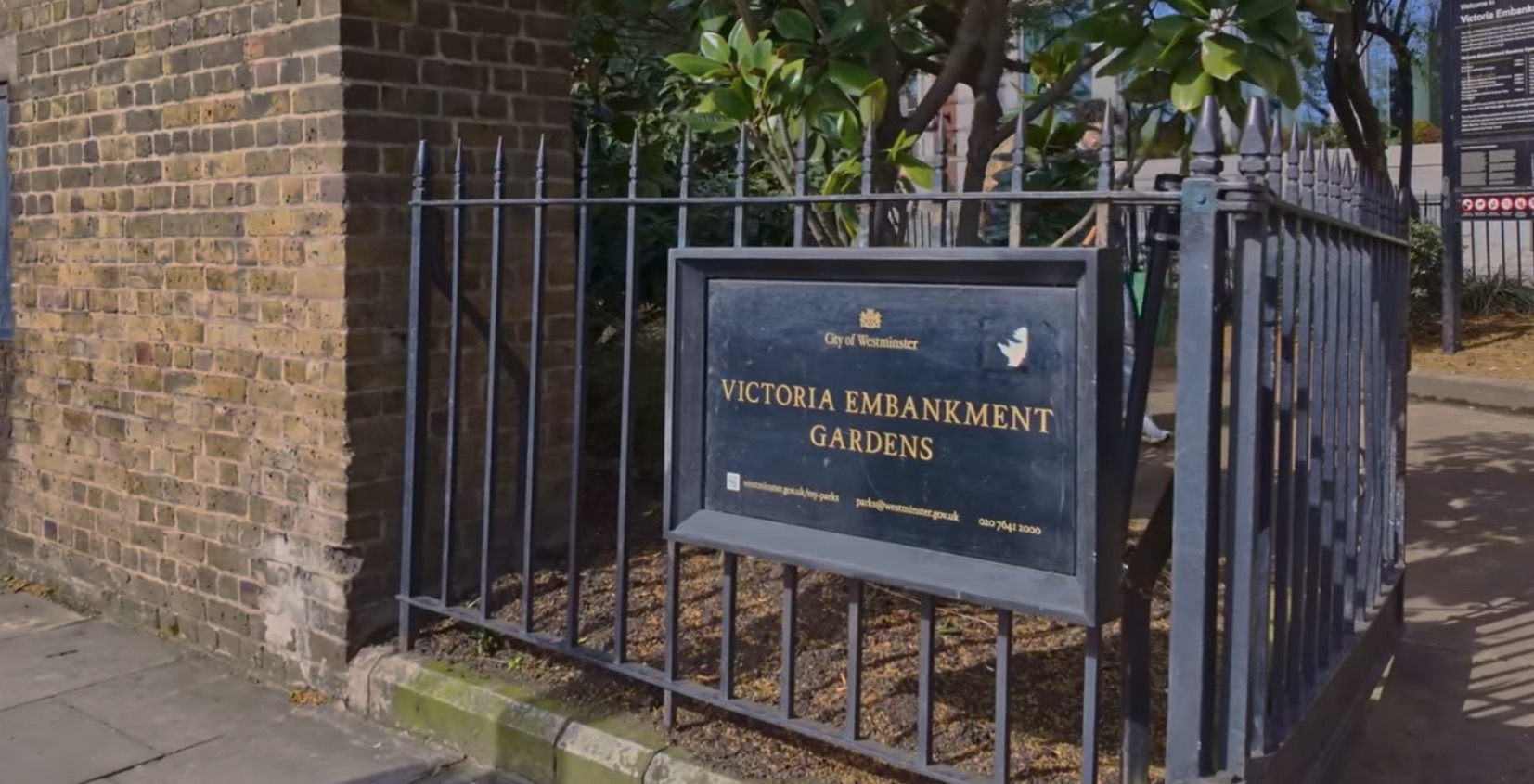
For a first visit, the Villiers Street/Embankment side is the most useful because it combines the station, toilets and York Water Gate. The Temple entrance at the eastern end works better if you are arriving from the City or the Inns of Court.
Seasonal Closing Times
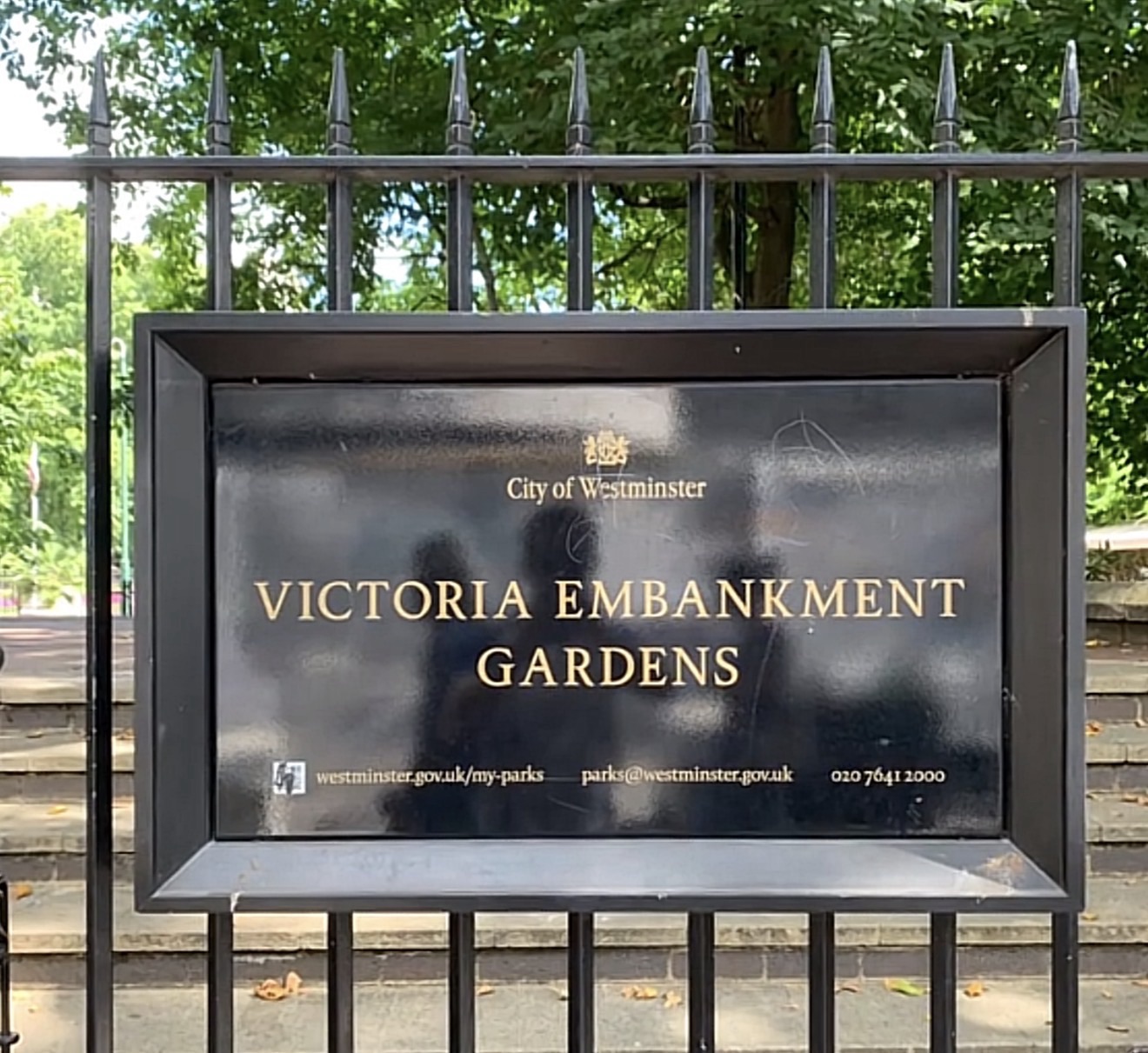
Westminster changes closing times with daylight. The board posted in the gardens carries the same schedule published on the council website:
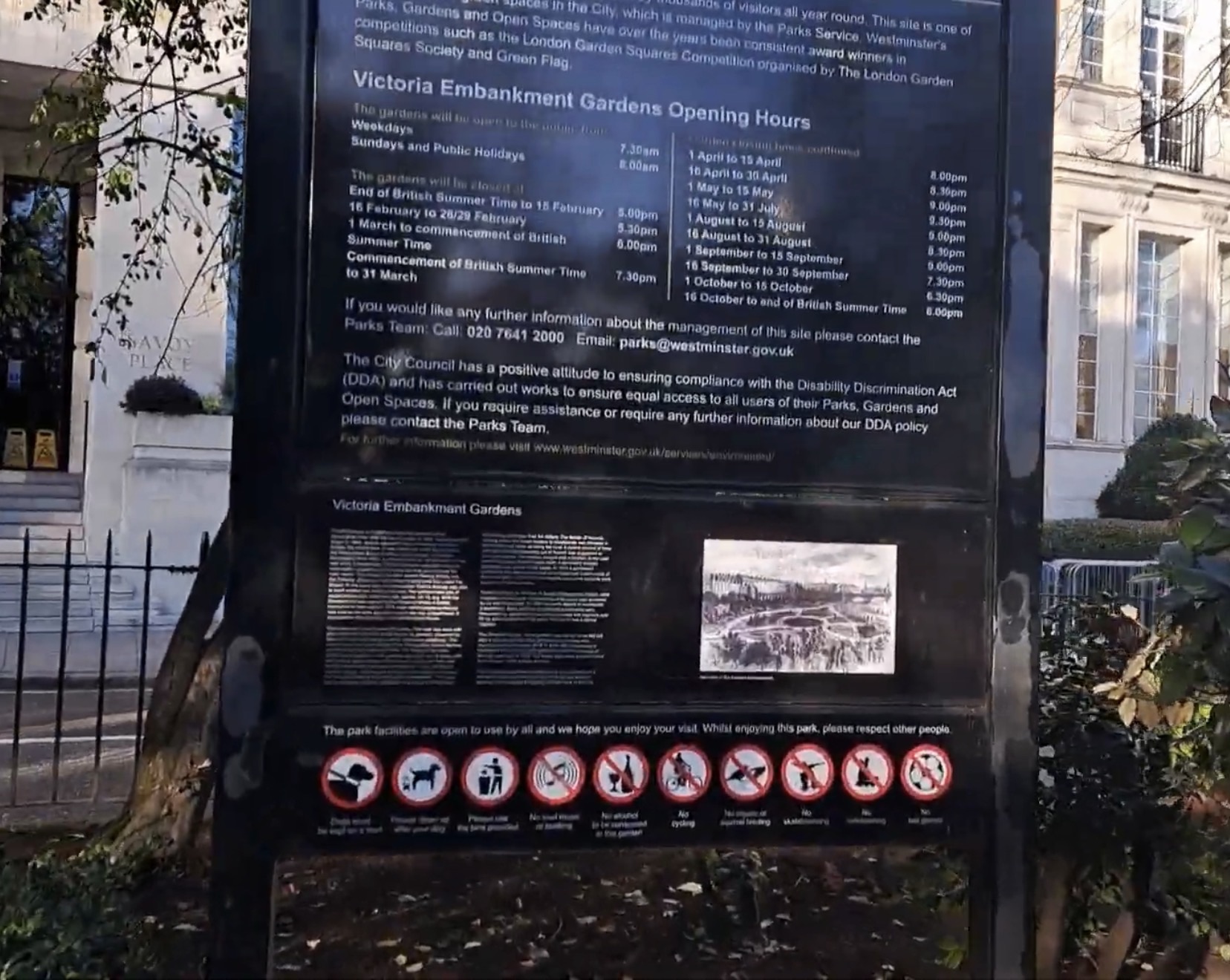
| Period | Closing |
|---|---|
| End of British Summer Time–15 February | 4:30pm |
| 16–end February | 5:30pm |
| 1 March–start of British Summer Time | 6:00pm |
| Start of BST–31 March | 7:30pm |
| 1–15 April | 8:00pm |
| 16–30 April | 8:30pm |
| 1–15 May | 9:00pm |
| 16 May–31 July | 9:30pm |
| 1–15 August | 9:00pm |
| 16–31 August | 8:30pm |
| 1–15 September | 8:00pm |
| 16–30 September | 7:30pm |
| 1–15 October | 6:30pm |
| 16 October–end of BST | 6:00pm |
Best Time to Visit
Spring Morning
Best for tulips, fresh planting and quieter photography around the Burns statue.
Summer Morning
Best for the Tropical Border before lunchtime crowds build.
Weekday Lunch
Convenient and lively, but benches and lawns can be busy.
Winter
Useful as part of a central walk, but the early closing time limits flexibility.
My Take
For me, that’s what makes a good park. It doesn’t necessarily have to be huge. If it has beautiful scenery, somewhere to sit and a peaceful atmosphere, that’s enough, and Victoria Embankment Gardens definitely has that. The fact that entry is free makes it even better: you can spend as much or as little time as you want here, and there’s plenty to see, especially when the flowers are blooming.
I came here simply to have a walk and enjoy the summer weather, and I really enjoyed the experience. Sometimes these simple moments, a coffee, a bench, flowers and a bit of fresh air right in the middle of London, are exactly what you need.
Nearby Places That Pair Well with the Gardens
The gardens make more sense as part of a central London route than as an isolated destination. Trafalgar Square and the National Gallery are uphill via Charing Cross. Covent Garden is a short walk north. Crossing Hungerford Bridge leads directly towards the South Bank, while following the river east takes you towards Somerset House and Temple.
Whitehall Gardens continue the idea of formal Embankment green spaces in the opposite direction. This works particularly well for someone who prefers a chain of smaller historic gardens to several hours in one large park. The Green Park and St James’s Park extend the same idea further west.
Who This Park Is Best Suited For
It suits visitors who want a quiet hour between central London attractions, office workers looking for an outdoor lunch spot, memorial and statue enthusiasts, garden lovers interested in seasonal planting, and anyone curious about how the Embankment changed the old Thames shoreline.
It is less suitable for people looking for a substantial playground, woodland walk or a day of sport. The gardens are useful precisely because they are small, central and easy to fit around something else.
Frequently Asked Questions
What is the best entrance?
The Villiers Street entrance beside Embankment station is the most practical for a first visit because it is close to public transport, toilets and York Water Gate. A second entrance near Temple suits arrivals from the City.
What time does the park open?
Westminster’s newer general opening-times page currently lists 7:30am, although the individual park page still says 8:00am. Check the council information before an early visit.
Is it suitable for wheelchairs or pushchairs?
Westminster lists disabled access, and the main garden routes are surfaced gravel and tarmac with no significant gradient. Transport accessibility should be checked separately with TfL.
Is there a children’s play area?
Yes, a small timber play area near the river wall with a boat structure and slide, useful for a short central London break rather than a destination playground visit.
What is the statue with the mourning figure?
That is the Arthur Sullivan Memorial, unveiled in 1903, showing a bronze bust of the composer with a half-draped mourning figure leaning against the pedestal below.
Is there a waterfall in the gardens?
Yes, a small waterfall feature is tucked into the gardens, adding a nice bit of extra character and atmosphere to a walk through.
How long should someone allow?
About 30–90 minutes is enough for the planting, York Water Gate, memorials and a short rest. Allow longer when combining it with the South Bank, Covent Garden or Trafalgar Square.
Research Method
This guide is based on a personal visit to the gardens during summer, combined with independent research. Photographs on this page are original. The history board text, statue inscriptions and opening-hours board were read directly on site; opening times, toilet hours and accessibility were checked against Westminster City Council, and the listed status of York Water Gate and the gardens was checked against Historic England. Changing details such as café hours and event dates should still be confirmed with the council before travelling.
Official & Useful Sources
Westminster City Council – Victoria Embankment Gardens
Used to verify the park’s location, planting, bandstand, disabled access, York Water Gate and principal memorials.
https://www.westminster.gov.uk/parks-and-open-spaces/victoria-embankment-gardens
Westminster City Council – Opening hours, disabled access and dogs
Used to verify the newer 7:30am opening listing, seasonal closing schedule, accessibility and dog policy.
https://www.westminster.gov.uk/leisure-libraries-and-community/parks-and-open-spaces/additional-information
Westminster City Council – Public toilets
Used to verify the Villiers Street toilets, accessible facilities, RADAR access and current opening hours.
https://www.westminster.gov.uk/leisure-libraries-and-community/public-toilets
Historic England – Victoria Embankment Gardens
Used to verify the Grade II* registered status and relationship with reclaimed Thames land.
https://historicengland.org.uk/listing/the-list/list-entry/1000844
Historic England – York Water Gate
Used to verify the Grade I listing and identity of the historic water gate.
https://historicengland.org.uk/listing/the-list/list-entry/1237938
Transport for London – Embankment Underground Station
Used to verify the station location and Bakerloo, Circle, District and Northern line connections.
https://tfl.gov.uk/tube/stop/940GZZLUEMB/embankment-underground-station
On-site interpretation read during the visit
The main Victoria Embankment Gardens history board, the opening-hours notice board, and statue and memorial inscriptions for Robert Burns, Robert Raikes, Henry Fawcett, the Imperial Camel Corps and Arthur Sullivan.
Last checked: 9 September 2026
Author
Steve visits every park featured on EKS Parks in person, checking practical details against councils, park operators and official sources. Every guide is based on a personal visit, and the photographs published with it are his own.
About Steve