

Gunnersbury Park… honestly, I didn’t expect it to be like this. The first thing that hits you when you get here is the size of the place. It’s huge. You start walking and you’re thinking, okay, where do I even go first?
Gunnersbury Park sits between some very busy West London roads, yet inside it spreads across about 72 hectares of Grade II* listed parkland with two historic mansions, lakes, gardens, a free museum, play space, mini golf and a major sports hub. There’s so much open space, so many trees and such a wide area to explore.
It was a warm summer day, and you could definitely see that the dry weather had taken its toll on the grass. A lot of it had turned yellow and brown, but somehow it still gave the park that proper summer look. And the views? Yeah, the views are actually really nice. That’s what surprised me most: you’re still in London, but once you’re walking through the park, it doesn’t really feel like it.
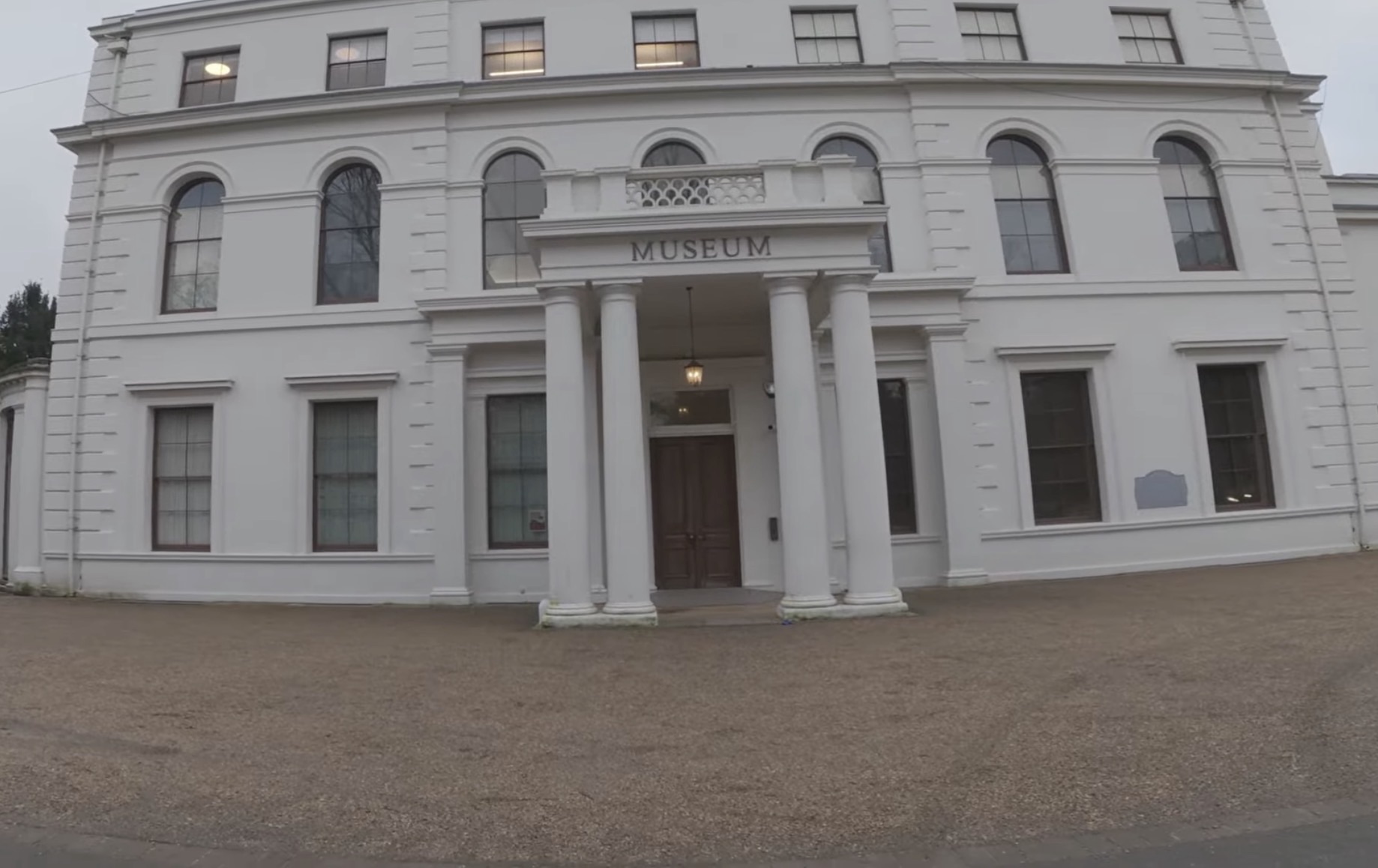
Three Things That Surprised Me
It’s not one of those parks you see in ten minutes
You actually need some time here. I kept finding different little areas as I walked further into the park. That’s the thing about Gunnersbury Park: you think you’ve seen it, then you walk a little further and there’s another view, another open space or another part of the gardens.
It goes quiet the moment you want it to
I really liked how quiet some parts were. You can get away from the busier areas and just have a peaceful walk with hardly any noise around you. It’s very relaxing, and despite how big the park is, that quiet feels easy to find rather than a rare exception.
There’s a real sense of history everywhere
The historic buildings and gardens give the whole place a different character. You can definitely feel that as you move around, and it turns a simple walk into something that keeps giving you a reason to stop and look.
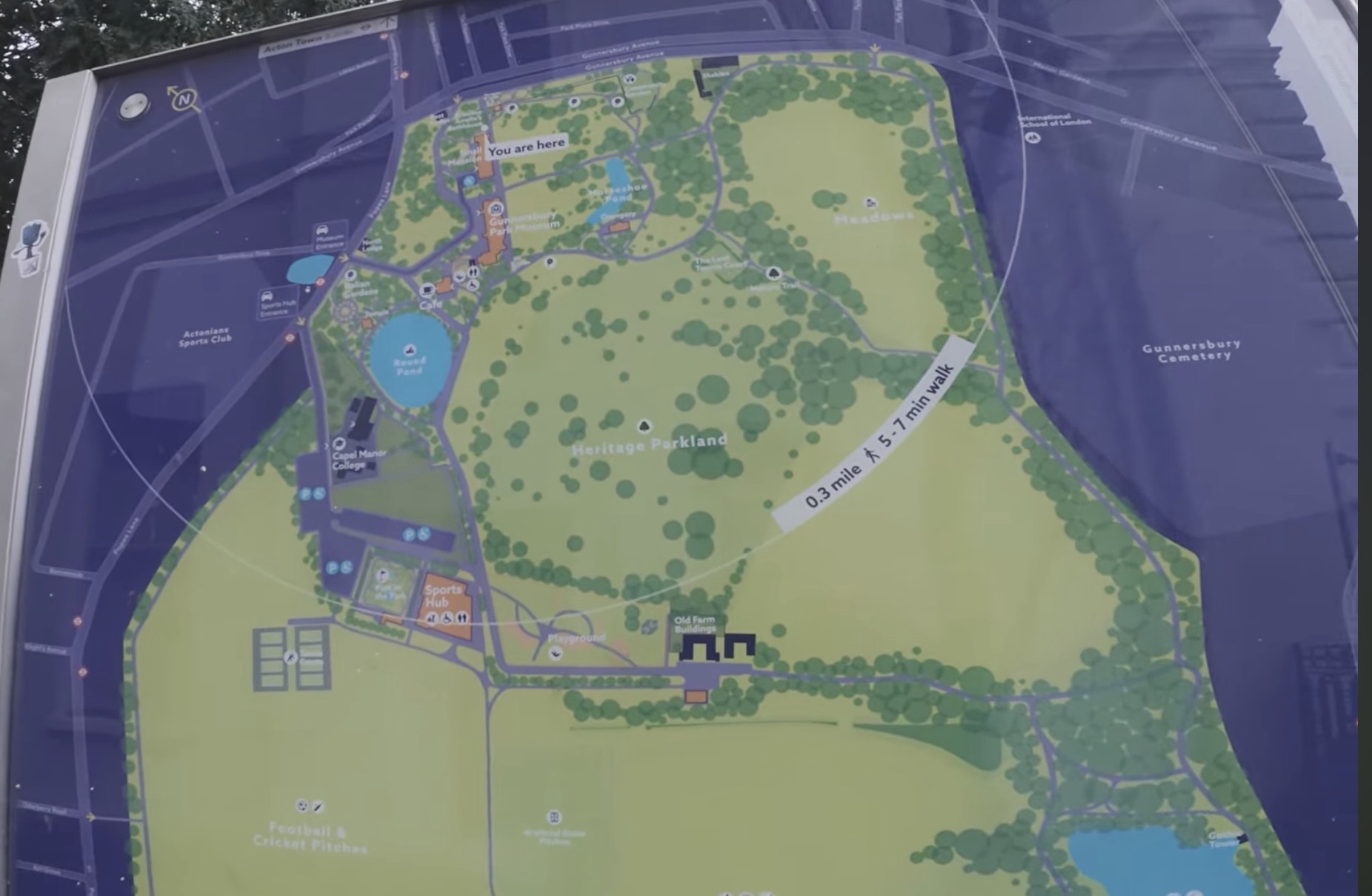
Which Entrance Makes Most Sense?
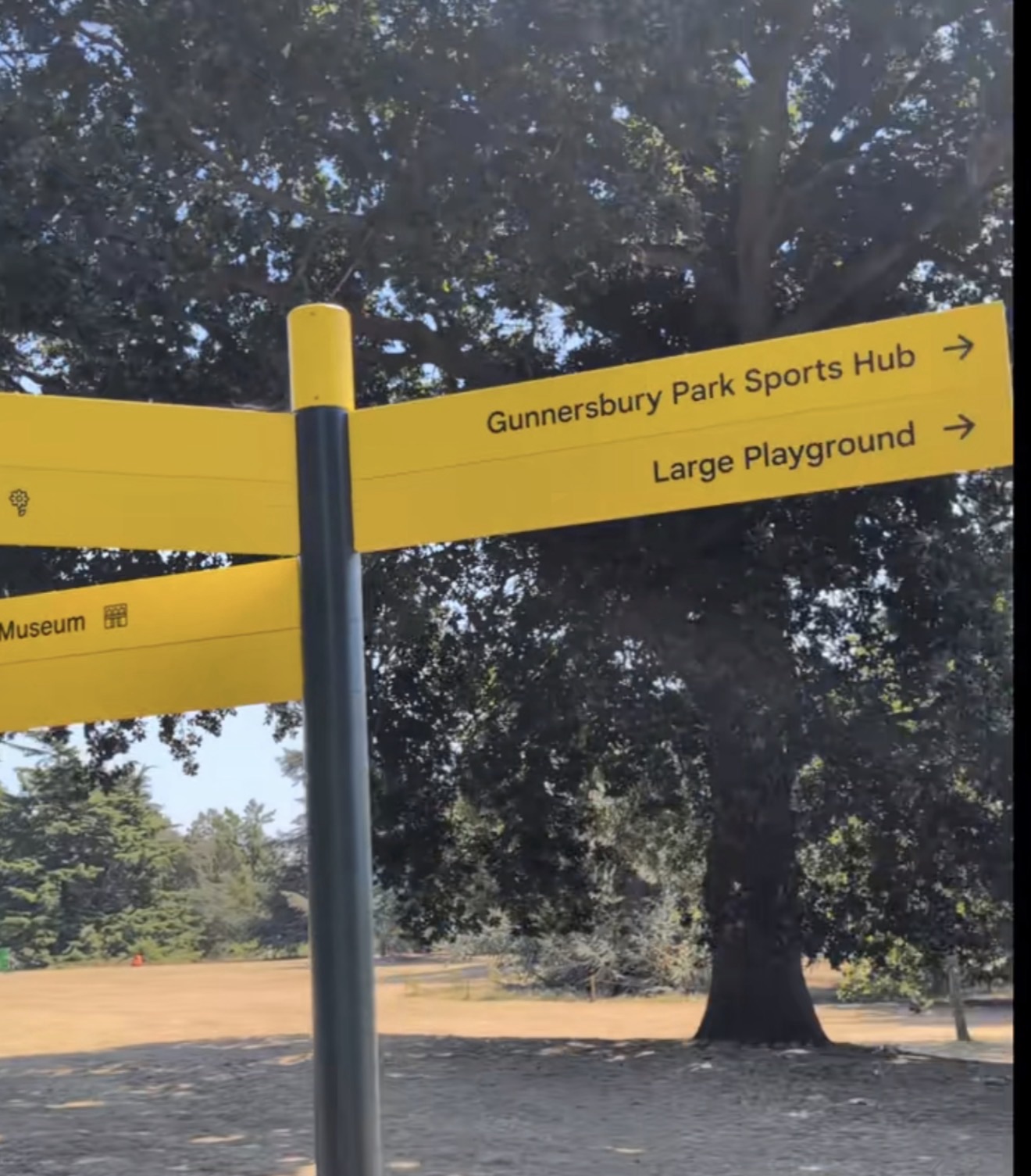
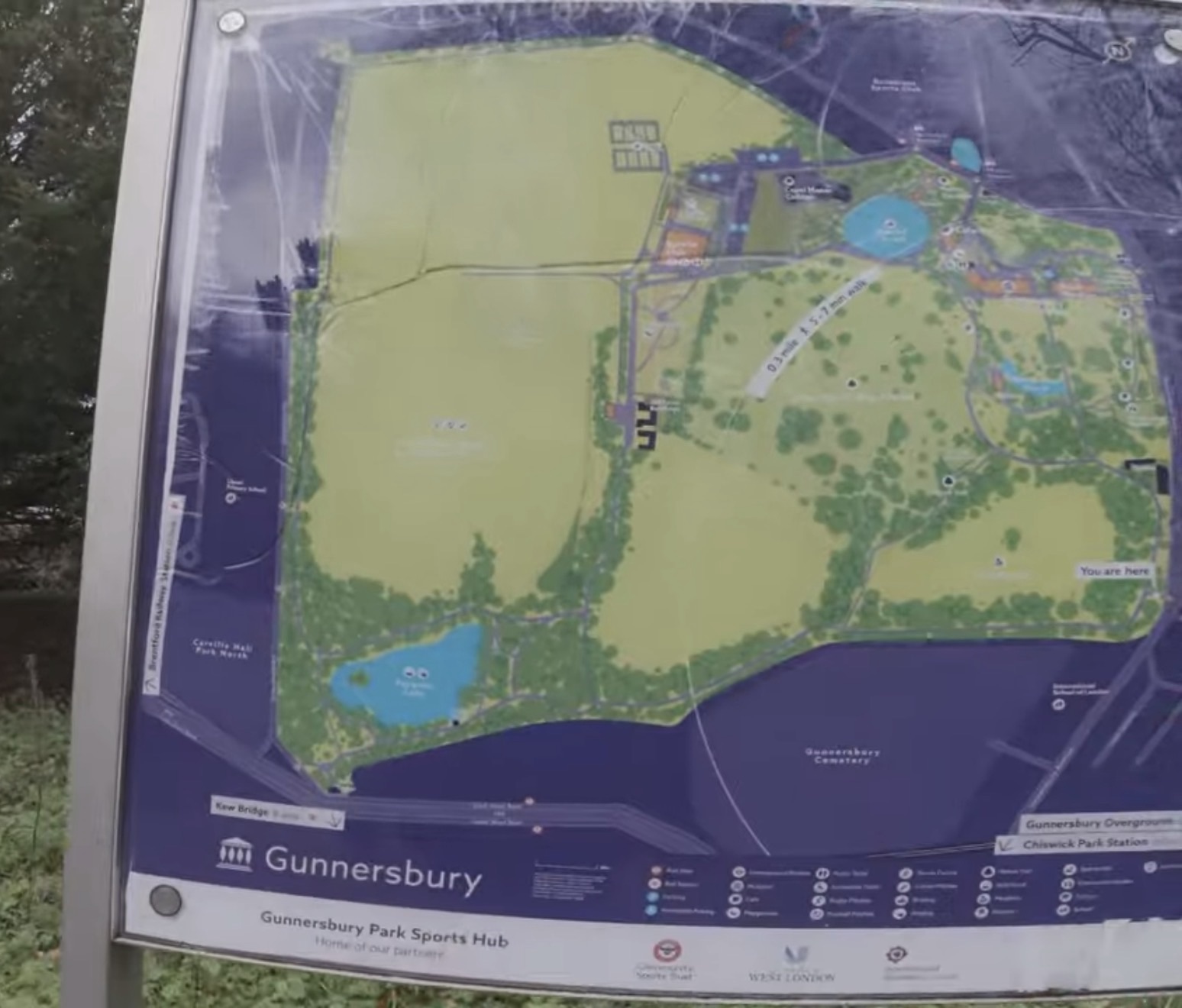
The decorative Popes Lane gates are the most useful choice for a first visit because they lead towards the Large Mansion, museum, café and historic estate. The Sports Hub has its own practical entrance from Popes Lane and makes more sense for gym, pitches, tennis or mini golf.
Lionel Road serves the southern park and is convenient from Kew Bridge station. Acton Town and South Ealing both give roughly ten-minute walks to the northern side, although the Acton Town route includes the A406 crossing.
The Free Museum Is More Than a Stately-House Tour
Gunnersbury Park Museum occupies the Large Mansion and focuses on the history of Ealing and Hounslow as well as the estate itself. The wider collection contains around 50,000 museum and archive items, covering subjects such as local industry, domestic life, transport, fashion and childhood.
The museum is currently open Tuesday to Sunday from 10:00am to 4:30pm. Mondays are normally closed apart from booked school visits and some Bank Holiday arrangements. Parts of the building can occasionally close because of private events or limited room stewarding, so check before making a special museum-only journey.
The Historic Kitchens usually open Thursday to Sunday, 10:00am–4:30pm, but school bookings and available stewards can affect access.
Historic Landscape: What Is Actually Worth Walking To?
The museum is only one part of the estate. Outside, the Large Mansion terrace looks across the lawns, while the Small Mansion, Orangery, Bath House, Temple, lakes and formal planting show how the site worked as a private country estate.
Not every historic structure is open. Gunnersbury has 22 listed buildings and structures, and several remain on Historic England’s At Risk register. Fencing or fragile-looking buildings are therefore part of an ongoing conservation story rather than necessarily a temporary failure.
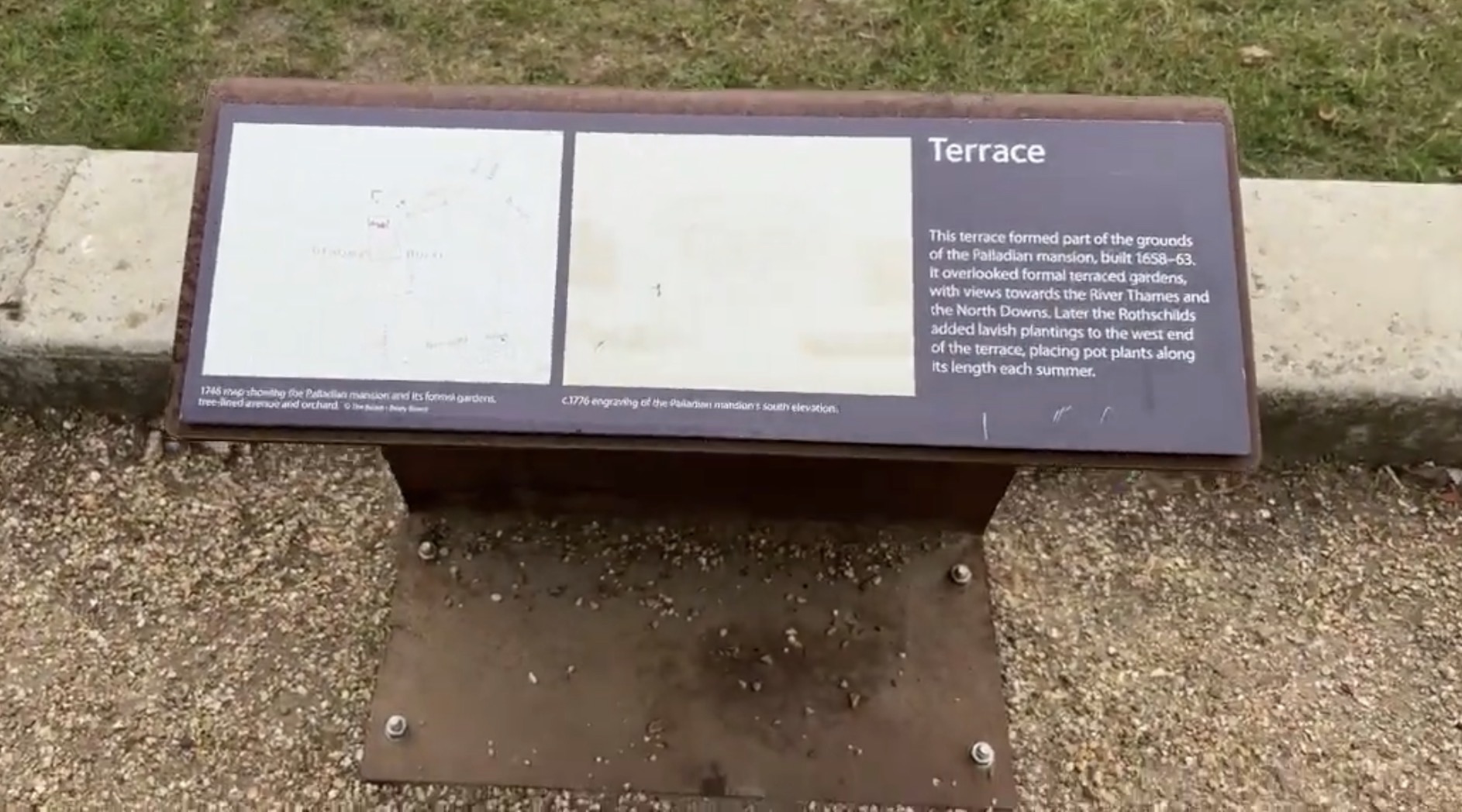
A board on the terrace fills in a piece of the story that predates the Rothschild era most visitors associate with the estate: this level once formed part of the grounds of an earlier Palladian mansion, built 1658–63, with formal terraced gardens looking towards the Thames and the North Downs. The Rothschild family, who bought the estate in the nineteenth century, later added lavish plantings and summer pot plants along the same terrace.
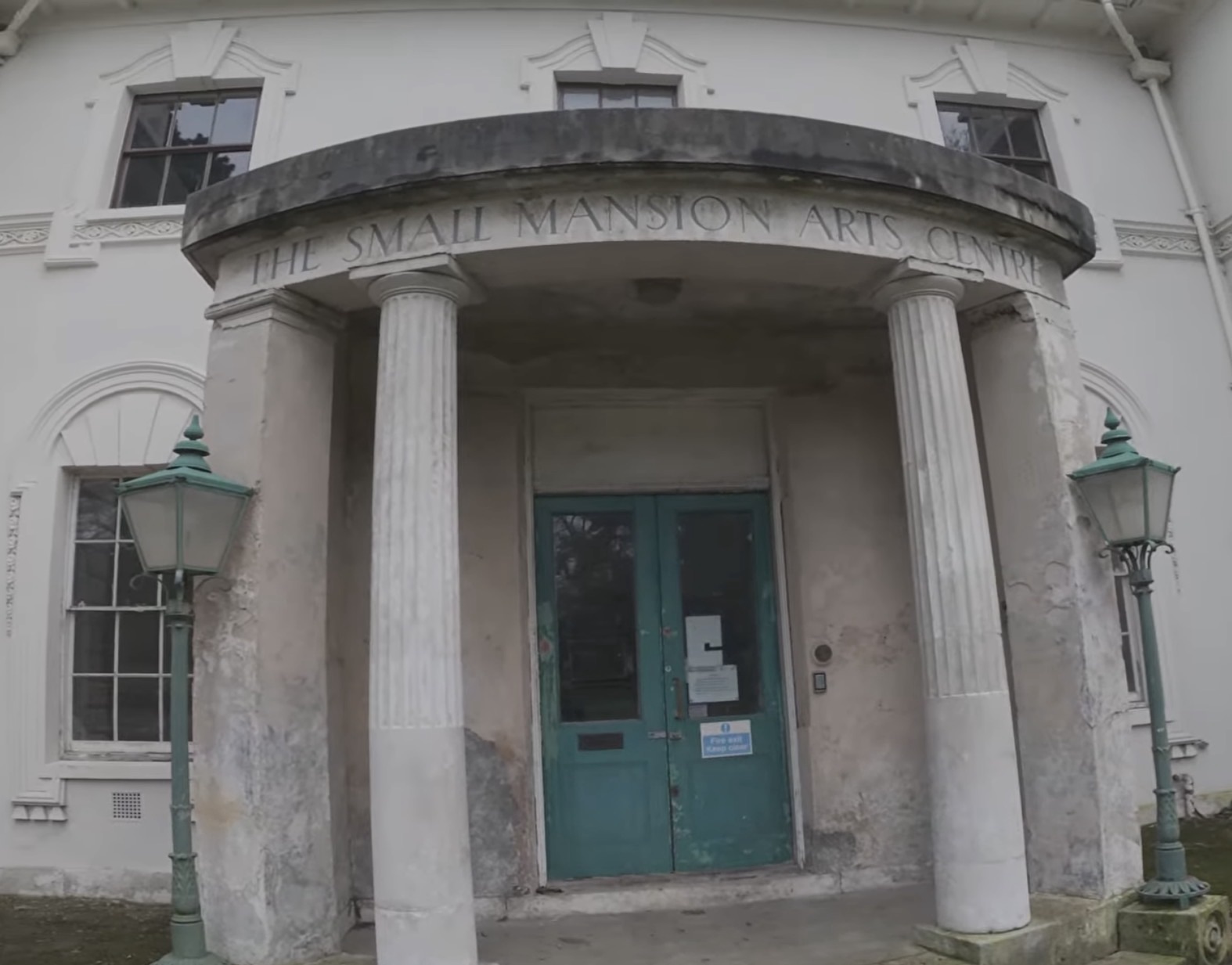
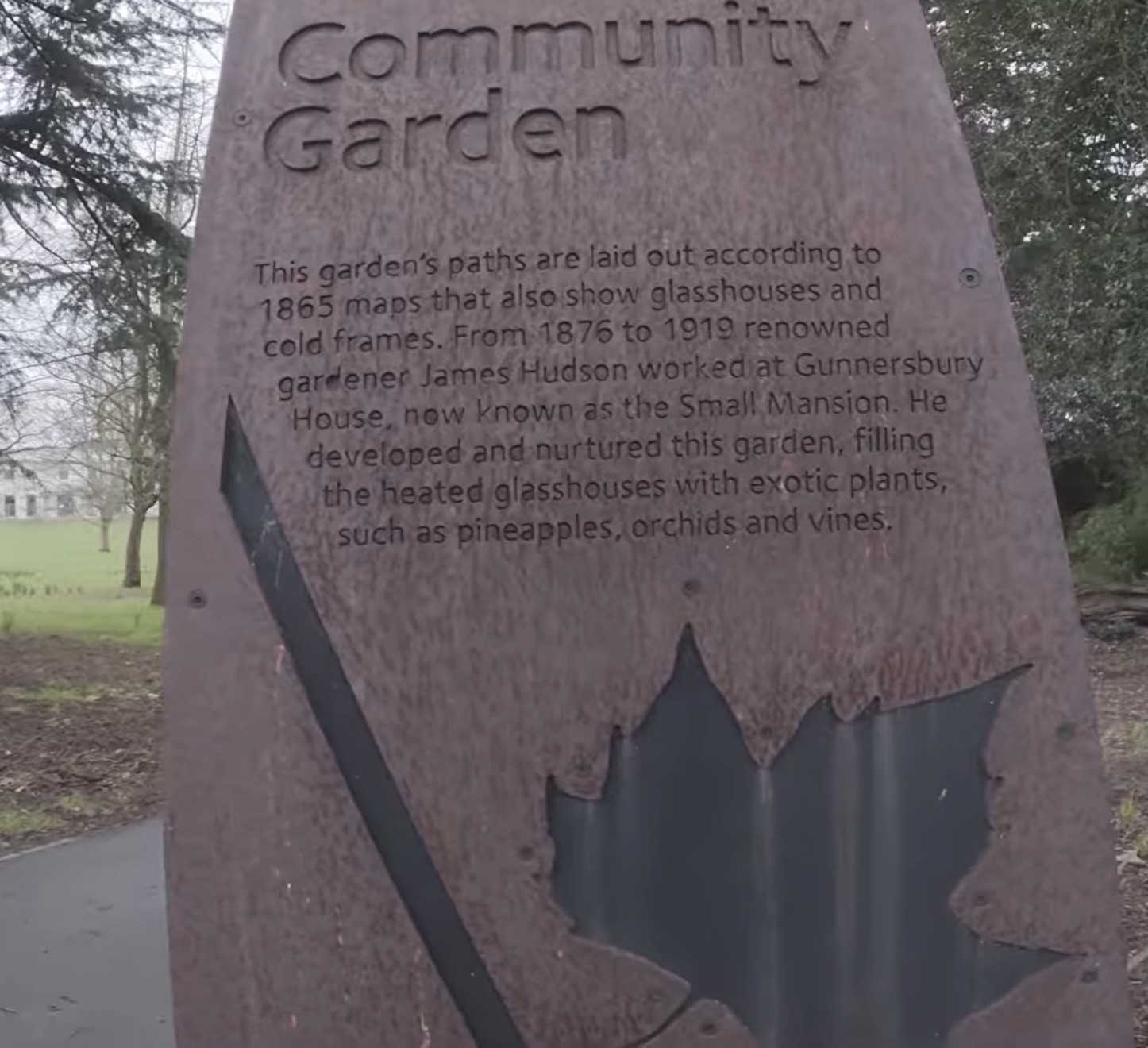
The Small Mansion itself, known historically as Gunnersbury House, now operates as the Small Mansion Arts Centre. Just beside it, a Community Garden marker explains that its paths still follow an 1865 map that also showed glasshouses and cold frames. Between 1876 and 1919, the renowned gardener James Hudson worked here, filling the heated glasshouses with pineapples, orchids and vines.
The rose garden is an easy seasonal detour, with more than 100 roses referenced in the official visitor information. Nearby meadow planting gives the formal estate a softer edge in warmer months, at least when the summer hasn’t already dried it back.
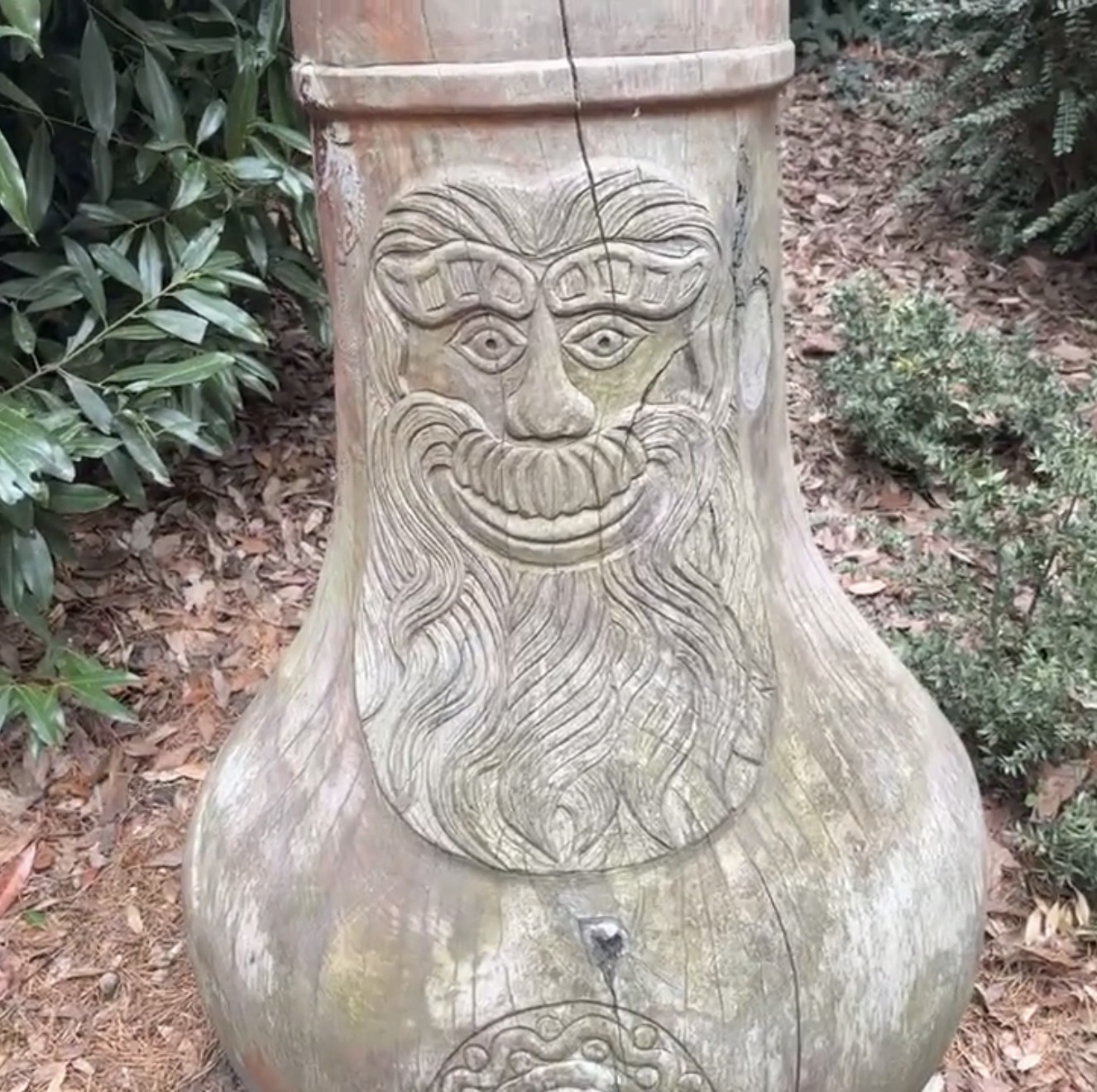
The Tree Trail
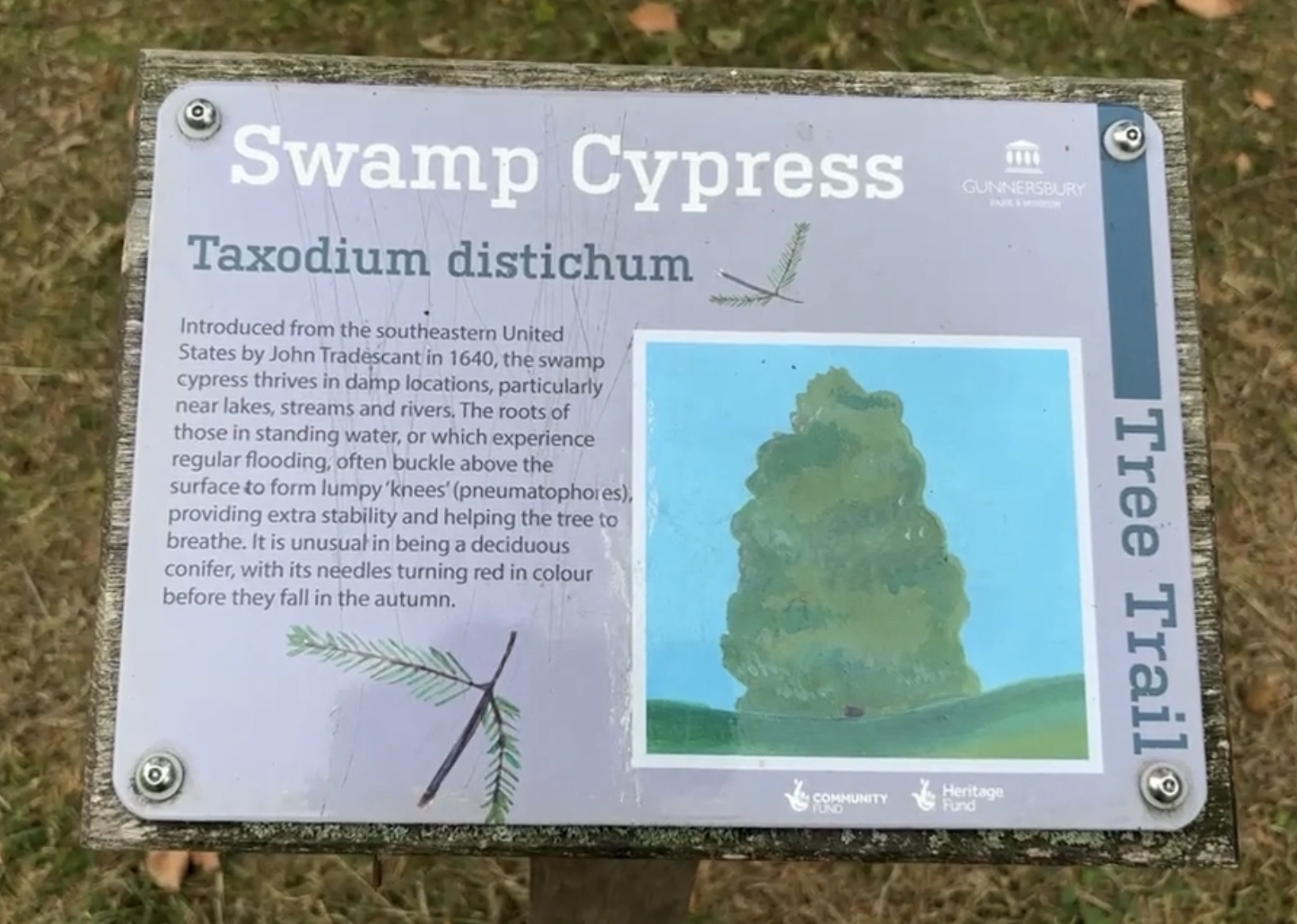
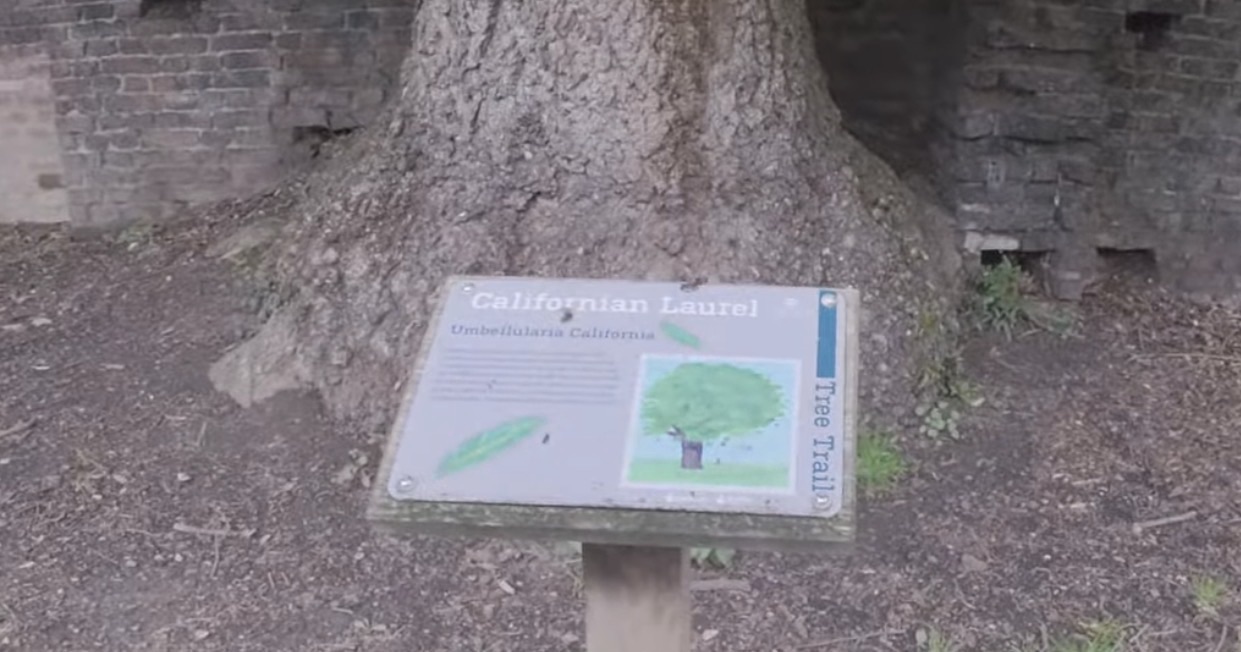
A marked Tree Trail runs through the park with small labelled boards at individual specimens, which turns an ordinary walk into something closer to an outdoor arboretum visit. Two worth looking out for: the swamp cypress (Taxodium distichum), introduced from the southeastern United States by the plant collector John Tradescant in 1640, an unusual deciduous conifer whose roots can buckle above the surface into “knees” in waterlogged ground; and the Californian laurel (Umbellularia californica), found near one of the old estate walls.
The Humanitarian Memorial
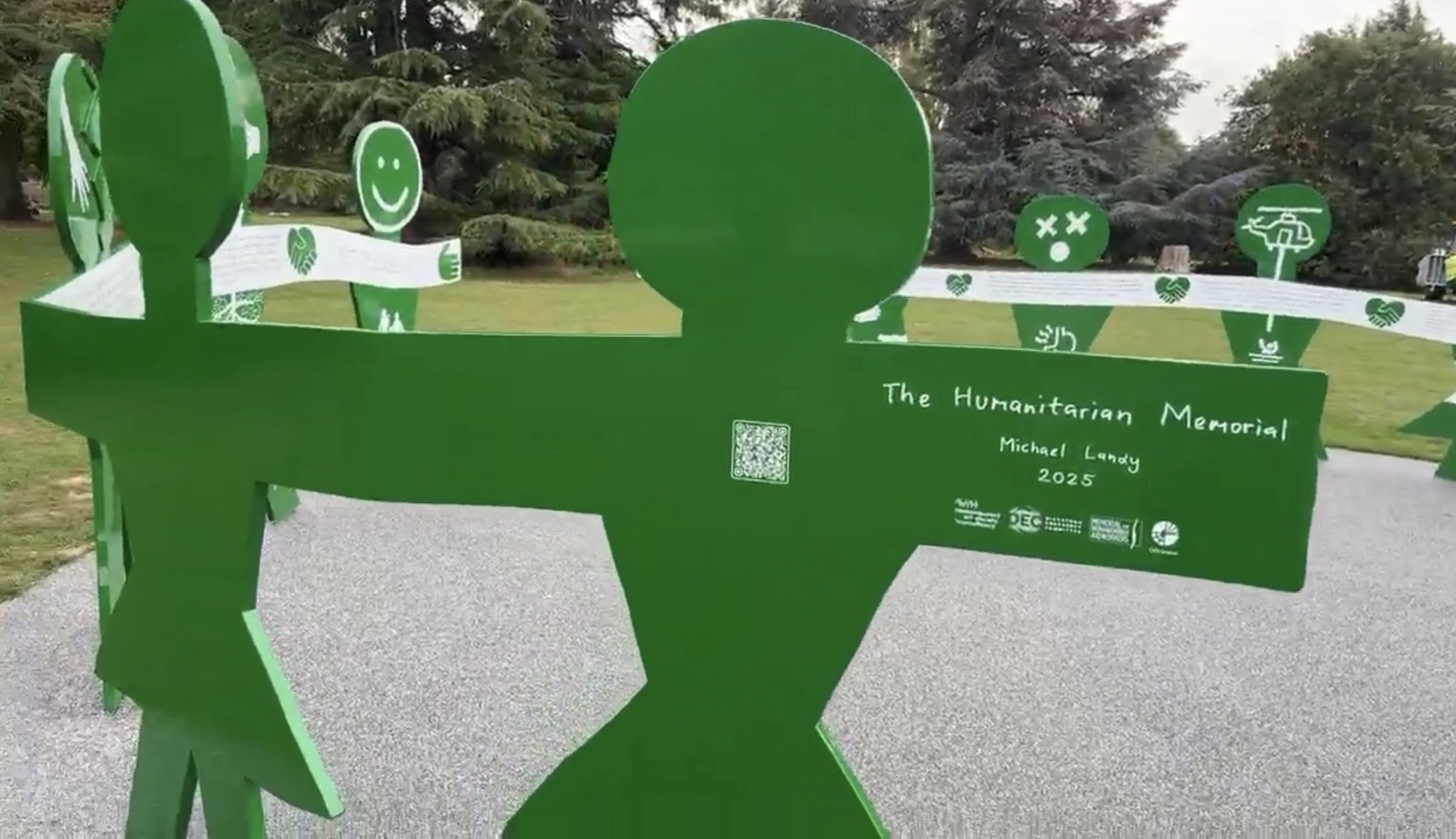
A newer addition to the park’s landscape is The Humanitarian Memorial, a 2025 installation by artist Michael Landy: a line of bright green, child-drawn-style figures with outstretched arms, each carrying simple pictogram icons, a helicopter, a handshake, a heart, representing humanitarian aid work. A QR code on one of the figures links to further information about the memorial and the aid organisations it references.
Round Pond and Seasonal Pedalos
Round Pond is one of the simplest family landmarks and gives the park a clear destination even when the museum is not part of the visit. The surrounding paths are useful for a short walk, while Potomac Lake and the Gothic-style Temple feel more like a historic landscape composition.
Pedalos operate seasonally in spring and summer, currently at weekends from 11:00am to 5:00pm, weather permitting, with extended hours during the summer holidays. They are first come, first served and cost £10 for half an hour, with card payment only.
How Well Does It Work for Families?
Quite well, mainly because indoor and outdoor activities can be mixed without paying for park or museum admission. There is a small play area beside the café, and the estate has a larger play area that is currently part of a centenary redesign project.
That redesign means families should check for phased changes or construction if play equipment is the main reason for travelling. The lawns and pond still give children space even when organised play is not the focus.
Mini Golf
Putt in the Park runs a 15-hole outdoor course near the Bowls Green Pavilion. Current prices are £14 for adults, £11 for children under 15 and £46 for a family of four. The operator says online prices exclude a 10% booking fee.
| Day | Current Hours | Last Tee-Off |
|---|---|---|
| Monday–Friday | 9:00am–7:00pm | 6:00pm |
| Saturday–Sunday | 9:00am–8:00pm | 7:00pm |
The course is not floodlit and operates weather permitting. Weekend advance booking is sensible.
Pure in the Park Café
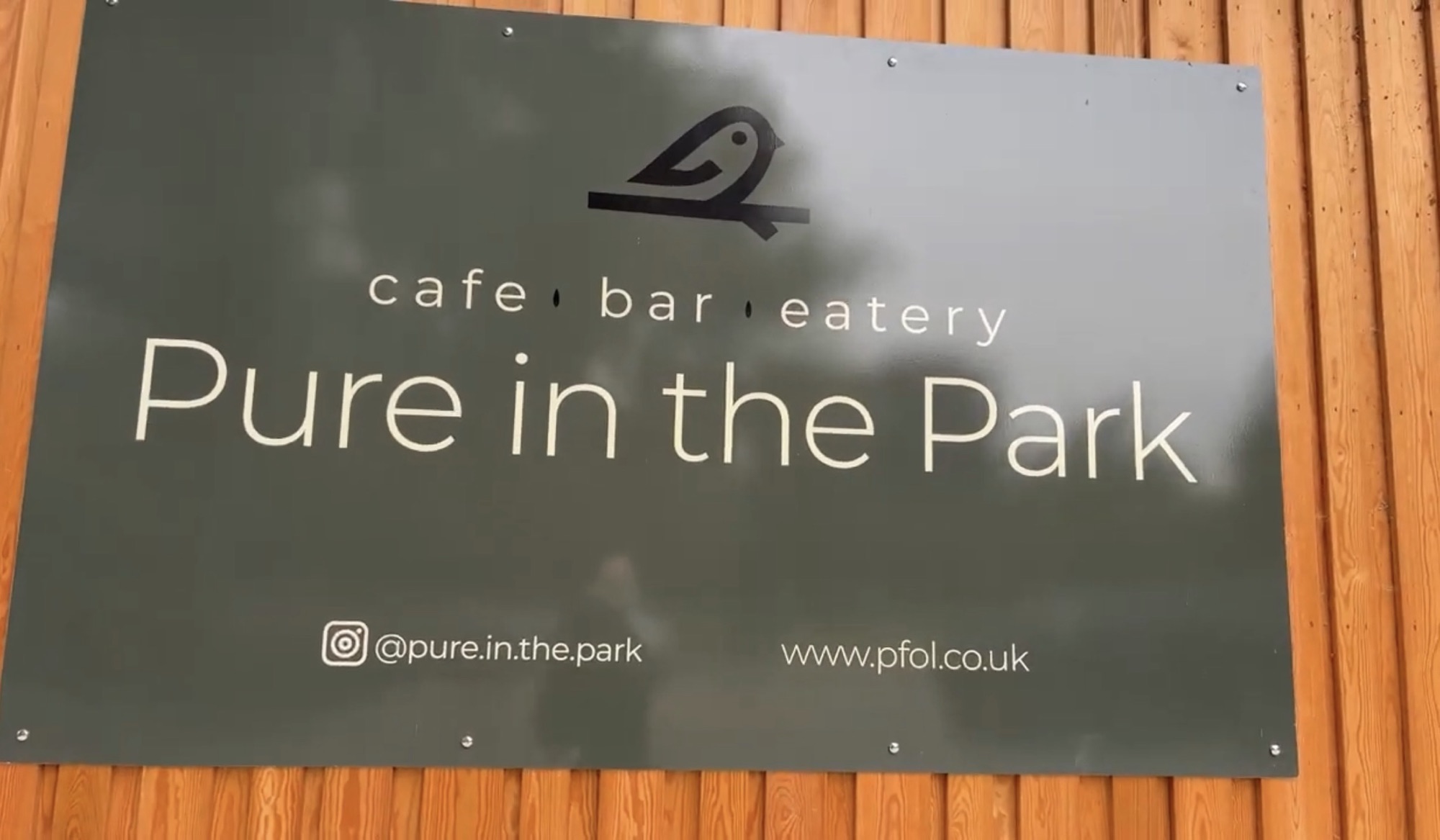
Pure in the Park opened in January 2026 beside the museum entrance. It has indoor and outdoor seating and is described by the estate as child- and dog-friendly. And honestly, it’s exactly what you want after walking for a while: grab a coffee, sit down for a bit, then carry on exploring.
Weekdays
7:00am–5:00pm
Weekends
7:00am–6:00pm
The early opening makes breakfast followed by a quiet park walk possible before the museum opens.
Sport Is a Major Part of the Park
The Sports Hub is not a small add-on. It includes a gym with more than 100 stations, two exercise studios, a competition-standard sports hall, eight tennis courts, two full-size all-weather pitches and ten grass pitches for football, rugby and cricket.
Current opening is 6:30am–10:00pm Monday to Friday and 8:00am–8:00pm at weekends. These are managed facilities with separate bookings, charges and memberships from the free park.
Walking, Cycling and Dogs
The park suits easy estate loops rather than a wilderness walk. Tarmac paths connect the main facilities, while some natural paths can be uneven or muddy after rain. Cyclists can enter from Lionel Road, Popes Lane and the A406 side, with racks near the museum and Sports Hub.
Dogs are welcome when controlled, but they are not allowed inside the museum or playgrounds, except Assistance Dogs. The Brentford dog control order also limits one person to four dogs. The café itself is dog-friendly.
Accessibility and Toilets
The museum has step-free entry, a lift to all gallery levels, seating throughout and an accessible ground-floor toilet. A manual wheelchair can be borrowed on request.
Outside, the main tarmac paths are the easiest routes. The mansion terrace has ramped access at both ends but uses compacted gravel, and some natural paths are uneven. A second accessible toilet is available in the park toilet block near the museum.
The museum also publishes quieter visiting periods and offers selected Relaxed Sessions with reduced sound and limited visitor numbers.
Parking Without Getting Caught Out
There are two main parking areas from Popes Lane: the larger Sports Hub car park and the smaller museum car park through the decorative gates. The museum car park currently has 19 standard spaces plus two designated Blue Badge spaces.
| Stay | Current Charge | What to Know |
|---|---|---|
| Up to 5 minutes | Free | No registration needed for drop-off/pick-up |
| Up to 30 minutes | Free | Registration required |
| 30 minutes–1 hour | £1 | Pay through RingGo or the machine |
| Longer than 1 hour | £1 per hour | Charges apply at all times |
| Blue Badge | Free | Badge and vehicle must be registered |
The free half-hour is not automatic. ANPR is used, so a short stay still needs registration.
Public Transport
Acton Town is served by the Piccadilly and District lines and is about ten minutes away on foot. South Ealing is on the Piccadilly line and is also around ten minutes from Popes Lane; the E3 bus stops by the park entrance.
Kew Bridge is the useful rail option for the southern gate. Route 65 serves South Ealing Road, while the H91 is useful for Lionel Road and Great West Road.
What Changes on Concert Days
Large concerts use part of the southern park. For ordinary visitors, the main effects are temporary fencing, altered walking routes, event vehicles and much larger transport crowds. Expect queues at the nearby stations when a large crowd leaves at the same time.
All major concerts for 2026 have now finished, but future summer visits should still be checked against the official event calendar.
My Take
Gunnersbury Park definitely surprised me. It’s big, it’s beautiful, it has history, and the atmosphere is really easygoing. People were walking around, sitting on the grass, enjoying the weather and taking pictures. Nothing felt rushed.
Especially on a warm summer day, it’s the kind of place where you can spend a few hours without even noticing how quickly the time goes. No need to rush around or do anything complicated. Just walk, look around, stop for a coffee, enjoy the scenery and keep exploring.
I’d definitely come back again.
How Long Should You Allow?
About 90 minutes is enough for the museum and a short café or pond stop. Three hours works better for a family visit with play and gardens. Add mini golf, pedalos or a longer heritage walk and the park can comfortably fill half a day.
Frequently Asked Questions
Is Gunnersbury Park free?
Yes. General park entry and Gunnersbury Park Museum are free. Parking, mini golf, organised sport, food and selected events cost extra.
When is the museum open?
Tuesday–Sunday, 10:00am–4:30pm. Mondays are normally closed apart from booked school visits and some Bank Holiday arrangements.
Can you hire pedalos?
Yes, seasonally. The current official listing gives spring and summer weekends from 11:00am–5:00pm, weather permitting, at £10 per half hour.
How does the free 30-minute parking work?
The vehicle must be registered promptly. The free period is not automatic simply because the stay is under half an hour.
Is the museum wheelchair accessible?
Yes. It has step-free entry, a lift, accessible toilet, seating and a wheelchair available to borrow. Some outdoor paths are less even.
Which station is best?
Acton Town and South Ealing suit the Popes Lane side; Kew Bridge is useful for the southern entrance. The best station depends on the facility you want.
Research Method
This guide is based on a personal visit to the park during a warm, dry stretch of summer, combined with independent research. Photographs on this page are original. The Terrace, Community Garden and Tree Trail boards, and the Humanitarian Memorial, were read and photographed on site. Museum hours, Historic Kitchens access, parking tariffs, accessibility and the Sports Hub were checked against Gunnersbury Park & Museum and Ealing Council; mini-golf and café details were checked with the individual operators. Prices and opening times change, so confirm before travelling.
Official & Useful Sources
Gunnersbury Park & Museum: Plan Your Visit
Used to verify opening times, Historic Kitchens, parking, transport, accessibility and toilets.
https://www.visitgunnersbury.org/plan-your-visit
Gunnersbury Park & Museum: Park
Used to verify size, heritage status, dog rules, pedalos and current play-area information.
https://www.visitgunnersbury.org/park
Gunnersbury Park & Museum: Accessibility
Used to verify step-free access, lift provision, toilets, wheelchair loan and quieter visiting periods.
https://www.visitgunnersbury.org/museum/accessibility
Ealing Council: Gunnersbury Park Sports Hub
Used to verify Sports Hub facilities and opening hours.
https://www.ealing.gov.uk/info/201193/sports_centres/2794/gunnersbury_park_sports_hub
Putt in the Park: Gunnersbury Park
Used to verify current mini-golf prices, hours and weather restrictions.
https://www.puttinthepark.com/mini-golf-courses/gunnersbury-park/
Gunnersbury Park & Museum: Pure in the Park Café
Used to verify the January 2026 café opening and its family- and dog-friendly setting.
https://www.visitgunnersbury.org/articles/cafe-reopening-on-5-jan
Last checked: 10 September 2026.
Nearby guides: Chiswick House and Gardens, Boston Manor Park and Acton Park
Author
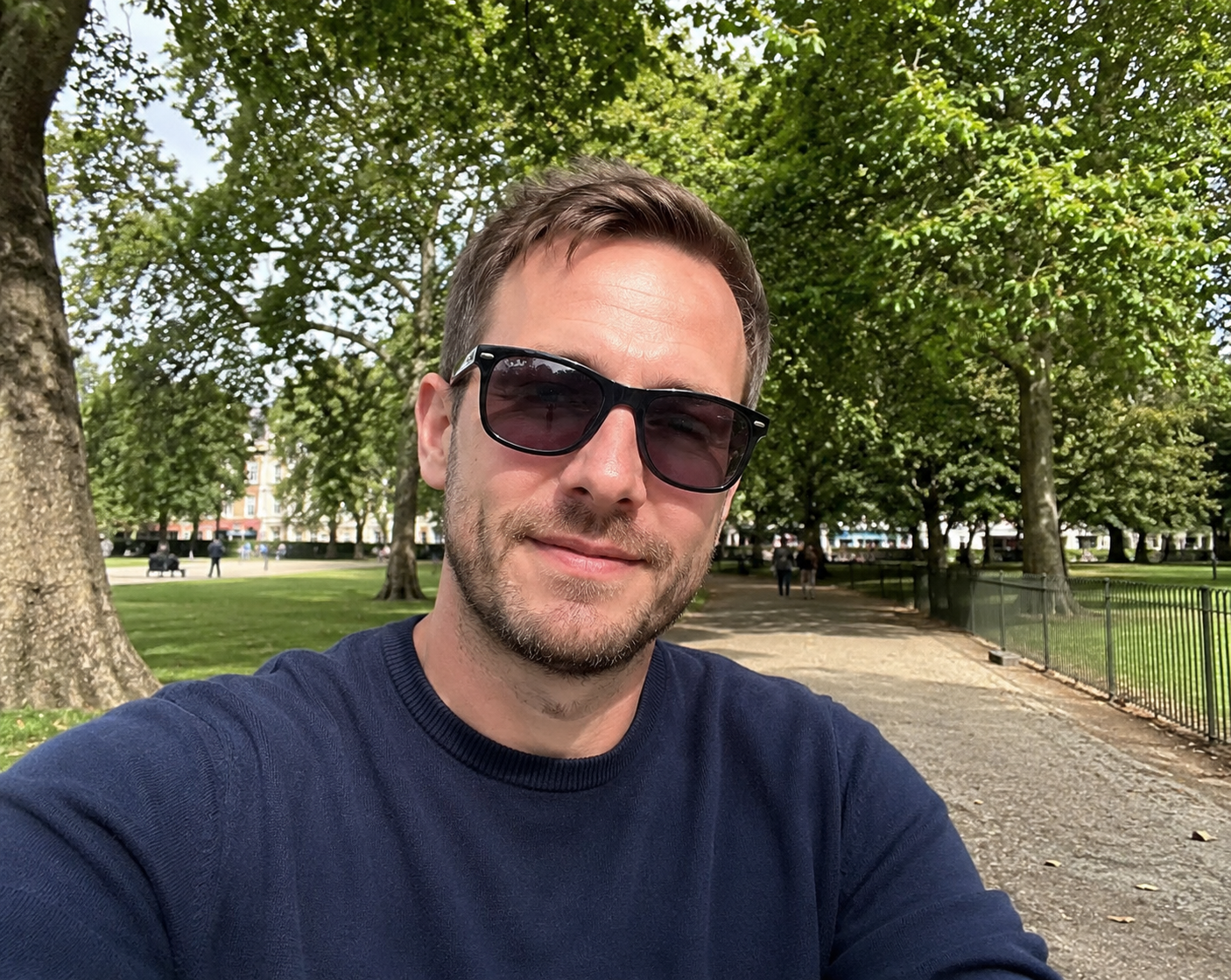
Steve visits every park featured on EKS Parks in person, checking practical details against councils, park operators and official sources. Every guide is based on a personal visit, and the photographs published with it are his own.
About Steve